What does caiman mean?
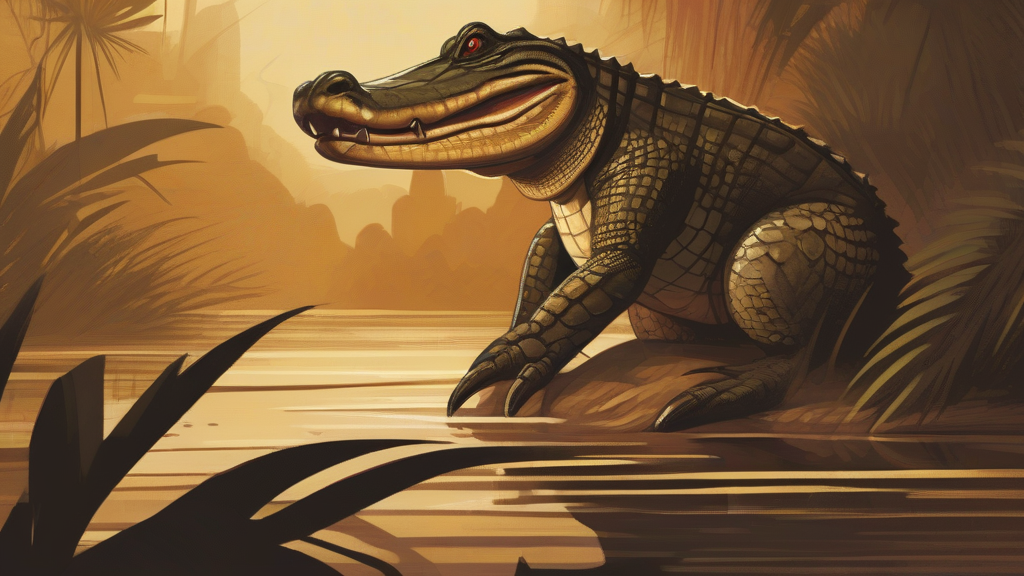
A caiman is a crocodilian reptile native to Central and South America, closely related to alligators and placed by zoologists in the subfamily Caimaninae. Smaller on average than true alligators or crocodiles, caimans are characterised by a distinctive bony ridge between the eyes, and range in size from the dwarf caiman, barely over a metre long, to the black caiman of the Amazon basin, one of the largest predators in South America. They are semi-aquatic, inhabiting rivers, swamps, and wetlands, where they prey on fish, amphibians, and other animals. In everyday English the word appears mainly in wildlife documentaries, nature writing, and travel accounts, often evoking the exotic danger of tropical waterways. Because several species are farmed commercially for leather, "caiman" also occurs in trade contexts. The plural is normally "caimans", though the unmarked form is common in scientific usage. The word derives from an indigenous Caribbean term adopted through Spanish into English.
nounA caiman is a semi-aquatic reptile of the alligator family (subfamily Caimaninae), native to Central and South America, resembling a crocodile or alligator with a bony ridge over its eyes.
- Any of various semi-aquatic crocodilians of Central and South America belonging to the alligator subfamily Caimaninae, typically smaller than alligators and distinguished by a bony ridge between the eyes.
"A caiman slid silently off the riverbank and vanished beneath the dark water."
"Tourists on the Amazon river cruise spotted a spectacled caiman basking on the muddy bank at dusk."
"The black caiman, which can exceed four metres in length, is one of the largest predators in the Amazon basin."
The standard English plural adds -s. In some zoological contexts the word is treated as an unchanged plural, but "caimans" is preferred in general use.
"Several caimans lay motionless along the bank, their eyes just above the waterline."
Caimans can survive in water too acidic or mineral-rich for many other crocodilians — some species thrive where their alligator cousins simply cannot.
Reviewed by Deb Chak, Editor. AI-assisted content curated by RJS Tech Solutions LLP.
Etymology of caiman
The word "caiman" entered European languages via Spanish "caimán", borrowed from indigenous languages of the Caribbean and northern South America — most sources trace it to a Taíno or related Arawakan term for a crocodile-like creature recorded by early Spanish explorers. It was adopted into English in the late sixteenth or early seventeenth century, when accounts of New World exploration described these American crocodilians to European readers. Related borrowings appear in French "caïman" and Portuguese "caimão", all reflecting the same colonial-era transmission from indigenous American speech into European natural history vocabulary.
How caiman is actually used
"Caiman" is used both for the animals collectively and as a countable noun for individuals. The plural is usually "caimans", though "caiman" itself is sometimes treated as an unchanged plural, especially in zoological writing. Spelling variants "cayman" and "caman" exist but "caiman" is now standard for the reptile.
Easily confused with caiman
Cayman most commonly refers to the Cayman Islands (or a Caribbean turtle of that name), while caiman refers to the South American crocodilian reptile; the two words are spelled similarly but entirely unrelated.