What does callithump mean?
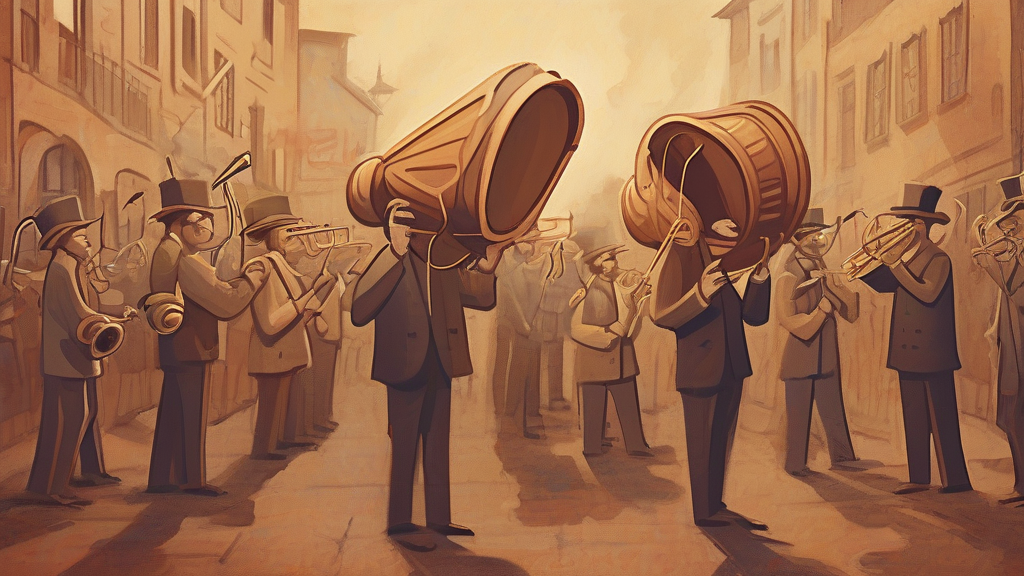
Callithump is a colorful American English noun denoting a noisy, boisterous mock parade or serenade, typically mounted by a crowd wielding whatever noisemakers come to hand: pots and pans, cowbells, tin horns, firecrackers, and other deliberately discordant instruments. The word can also refer simply to the uproar such a procession produces. Callithumps were traditionally associated with festive occasions — especially New Year's Eve celebrations in nineteenth-century America — though the underlying custom resembles older European practices such as the charivari, in which communities serenaded newlyweds or miscreants with rough music. The term carries a jocular, slightly antique connotation today; it survives mainly in historical accounts, folklore studies, and regional journalism about holiday parades. The related adjective 'callithumpian' describes anything connected with such a racketing procession. For writers seeking a vivid, characterful synonym for 'racket' or 'rowdy celebration', callithump offers precision and charm in equal measure.
A noisy, boisterous procession or mock serenade, usually celebratory, featuring discordant music made on improvised or mismatched instruments.
"The town's annual callithump wound through the square at midnight, drums clattering and horns bleating."
Often used in historical or folkloric contexts; the plural refers either to multiple such events or to the collective noises themselves.
The loud, chaotic noise or din characteristic of such a procession.
"We heard the callithump long before the marchers came into view."
Standard plural; used for multiple processions or, less commonly, for repeated bursts of the associated noise.
"Victorian newspapers described New Year's callithumps erupting in cities across the country."
A callithump is what happens when a whole town decides to celebrate by making as much glorious noise as humanly possible — no instruments required, pots and pans encouraged.
Reviewed by Deb Chak, Editor. AI-assisted content curated by RJS Tech Solutions LLP.
Etymology of callithump
Callithump arose in early nineteenth-century America as a fanciful, humorous coinage — likely a playful alteration of 'gallithumpian', a term used earlier for social unrest and disorder, blended with notions of thumping and racket. It belongs to a family of jocular American formations naming noisy communal celebrations, alongside 'shivaree' and 'horning'. Its derivative 'callithumpian' became established as the adjective describing such processions.
Related word forms
How callithump is actually used
A chiefly American word with a playful, old-fashioned flavor; it appears mostly in historical writing, local-color journalism, and descriptions of folk celebrations rather than everyday speech. Its adjective form 'callithumpian' is somewhat more familiar to modern readers.
Easily confused with callithump
Charivari is a related but older European custom of a noisy mock serenade to shame or celebrate someone, while callithump is the distinctly American term for a festive, often New Year's or holiday, noisemaking parade.