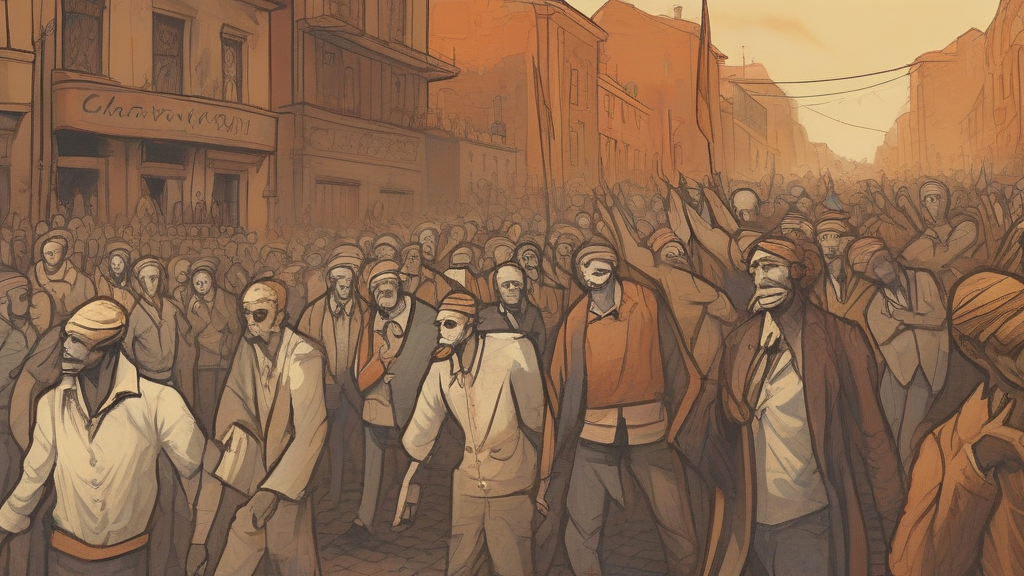
What does charivari mean?
A charivari is a noisy, discordant mock serenade — traditionally a crowd gathering outside the home of a newly married couple, banging pots and pans, blowing horns, and shouting, especially when the match was thought unsuitable or the couple unpopular. Rooted in medieval and early modern European folk custom, the practice served as a form of community censure dressed up as celebration, and the word has since broadened to describe any wild, cacophonous din or uproar. Today 'charivari' is a relatively rare, literary word, encountered most often in historical writing about folk ritual, in accounts of communal shaming customs, or figuratively in descriptions of chaos and noise. Its colorful history and vivid sound make it a striking choice for writers seeking a word that evokes both festive mischief and disapproving clamor.
A noisy mock serenade of discordant music and shouting, traditionally staged outside the home of a newly married couple as a form of teasing or community disapproval.
"The villagers staged a charivari outside the inn where the elderly groom was spending his wedding night."
Often used in discussions of European and American folk customs of public shaming.
A general loud, confused noise or uproar.
"The debate collapsed into charivari as each side tried to shout down the other."
Figurative extension of the original ritual sense; typically used in literary contexts.
The standard plural simply adds -s; the word is a regular countable noun, though it is frequently used in the singular even for repeated events.
"Local historians have documented dozens of charivaris held in the county during the nineteenth century."
In old French village custom, neighbors would 'celebrate' an unpopular wedding by gathering outside the couple's window all night, banging pots and pans — a tradition so rowdy that its very name descends from a Greek word for headache.
Reviewed by Deb Chak, Editor. AI-assisted content curated by RJS Tech Solutions LLP.
Etymology of charivari
Charivari entered English in the mid-17th century from French 'charivari', the name for the traditional noisy serenade given to mismatched or remarried couples. The French word derives from Late Latin 'caribaria' meaning 'severe headache', itself borrowed from Greek 'karebaria', a compound of 'kara' (head) and 'barys' (heavy) — literally 'heavy-headedness'. This Greek root also yields English words such as 'barometer', 'baritone', and 'baryon', all built on the same element meaning 'heavy' or 'weight'. An American folk variant, 'shivaree', arose through alteration of the word.
How charivari is actually used
A literary and somewhat rare word in modern English; it carries a historical or anthropological flavor and is most likely to be encountered in writing about folklore, social history, or music criticism (where it can describe deliberately riotous sound). The plural is usually the anglicized 'charivaris'.
Easily confused with charivari
Shivaree is an American folk variant spelling and pronunciation of the same word, referring specifically to a noisy wedding prank, whereas charivari is the standard form and can also mean any general uproar.