What does camp mean?
Camp is a versatile English word with several distinct senses. Most commonly it denotes a place of temporary shelter — a collection of tents, huts, or similar structures where people stay for a period, whether soldiers at a military base, families at a summer camp, aid workers at a refugee camp, or hikers pitching a tent for the night. It also names the activity itself: to camp is to lodge outdoors in a tent or makeshift quarters, usually for recreation. In informal usage, especially since the mid-twentieth century, camp describes a deliberately exaggerated, theatrical, or flamboyantly artificial style that is enjoyed precisely because of its excess. The word traces back through Old French to the Latin campus, meaning an open field, which also gives us campaign, campus, and champion. Its flexibility across literal and stylistic contexts makes it a rich and enduring part of everyday English.
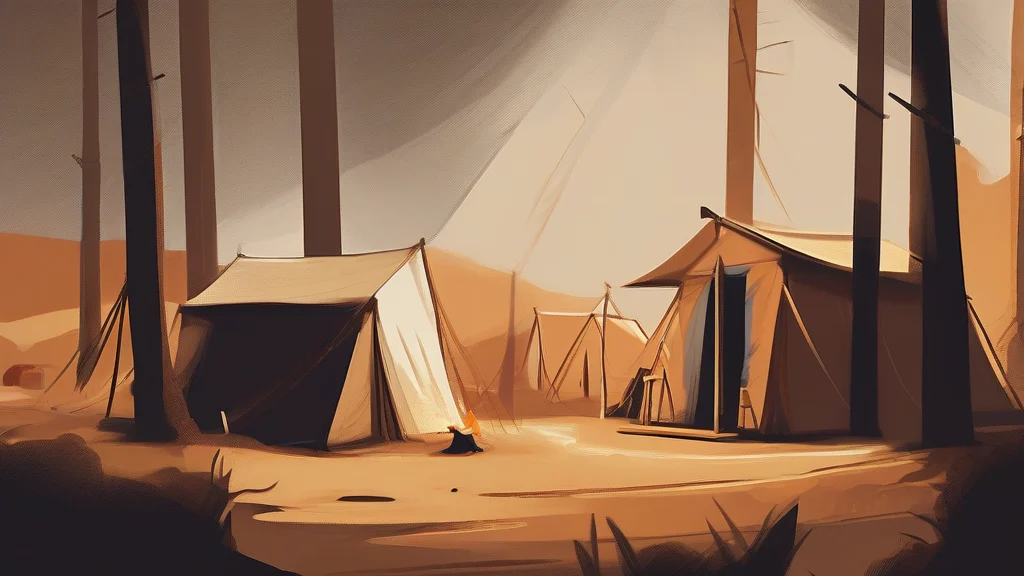
A place with temporary accommodation consisting of tents, huts, or other structures, used by soldiers, refugees, holidaymakers, or groups such as scouts.
"The refugees were moved to a camp near the border."
Common compounds include summer camp, boot camp, concentration camp, and prisoner-of-war camp.
To live for a short time in a tent, hut, or other temporary shelter, typically outdoors for recreation.
"They camped under the stars along the riverbank."
Deliberately exaggerated, theatrical, or flamboyant in style; amusing because of its excessive artificiality.
"The film's over-the-top villains and sequined sets give it an unmistakably camp quality."
Informal register; strongly associated with drag culture, cabaret, and queer aesthetics.
Standard plural; also serves as the third-person singular verb form.
"Several summer camps operate along this stretch of coastline."
Camp and campaign share a battlefield: both come from the Latin campus, the open field where Roman soldiers pitched their tents — and where candidates once 'took the field' to win votes.
Reviewed by Deb Chak, Editor. AI-assisted content curated by RJS Tech Solutions LLP.
Etymology of camp
Camp entered English in the early sixteenth century from Middle French camp or campe, meaning an open field where troops encamped, ultimately deriving from the Latin campus, an open field or plain. The same Latin root produced campaign, campus, and champion (via Late Latin campio, a combatant in the field). The adjective sense meaning theatrically exaggerated arose separately in the early twentieth century, likely influenced by French camper, 'to pose or posture in an exaggerated way.'
Related word forms
How camp is actually used
As an adjective meaning exaggerated or theatrically artificial, 'camp' is informal and derives from French camper ('to pose in an exaggerated fashion'); it is central to discussions of queer aesthetics and popularized widely after Susan Sontag's 1964 essay 'Notes on Camp.' The outdoor sense is neutral and common in both British and American English.
Easily confused with camp
'Camps' is simply the plural or third-person form of the same word, not a separate term.
'Campy' is the adjective describing deliberately exaggerated, theatrical style (the 'camp' aesthetic), whereas 'camp' most commonly refers to a temporary settlement or the act of camping outdoors.