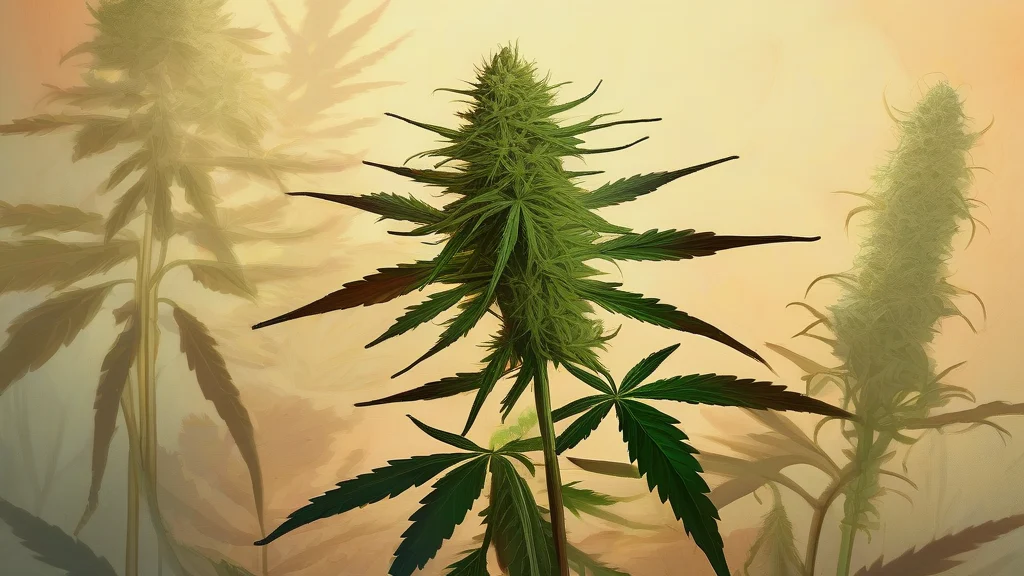
What does cannabis mean?
Cannabis is a noun referring both to a tall annual herb of the genus Cannabis and to the drug prepared from its dried flowering tops and leaves. As a plant, cannabis has been cultivated for thousands of years: its strong bast fibres yield hemp used for rope, canvas, and textiles, while its seeds provide food and oil. As a drug, cannabis contains psychoactive compounds — chiefly THC — and is smoked or ingested for recreational or medicinal purposes, with effects that include relaxation, altered perception, and appetite stimulation. Legally, the word sits at the centre of ongoing debates about prohibition, decriminalisation, and medical access, and many jurisdictions now distinguish low-THC hemp from high-THC cannabis. In formal writing — medical, scientific, or legal — 'cannabis' is the preferred term, whereas 'marijuana' and slang terms such as 'weed' or 'pot' carry informal or historically loaded connotations. The English word derives via Latin from Greek kannabis, making it a linguistic relative of 'canvas'.
nounA tall annual herbaceous plant of the genus Cannabis, cultivated for its fibrous stems, edible seeds, and psychoactive resins; also, the drug derived from its flowering tops and leaves.
- The psychoactive drug (marijuana) prepared from the dried flowering tops and leaves of the Cannabis plant, used recreationally or medicinally.
- The plant itself — any member of the genus Cannabis, including varieties grown for hemp fibre and seed.
"The farmer rotated his hemp fields with cannabis grown for industrial fibre."
"She was prescribed medicinal cannabis to help manage chronic pain."
"Hemp and cannabis belong to the same species but have been bred for very different purposes."
Rarely pluralised; the plural is used mainly when referring to multiple plants or species collectively (e.g. different cultivars of cannabis).
"Researchers compared several cannabises bred for differing cannabinoid profiles."
The word 'cannabis' and the word 'canvas' are cousins — the fabric was once woven from the very same plant.
Reviewed by Deb Chak, Editor. AI-assisted content curated by RJS Tech Solutions LLP.
Etymology of cannabis
The word cannabis entered English in the late 17th century, borrowed directly from Latin cannabis, which itself came from Greek κάνναβις (kánnabis). The Greek term is thought to be a loanword, possibly via Scythian or Thracian, from an earlier non-Indo-European source, so its ultimate origin is uncertain. Latin cannabis gave rise to related forms across European languages, and through the same lineage English also inherited 'hemp' (from Proto-Germanic *hanapiz, an early borrowing of the same Mediterranean word) and 'canvas', which derives from cannabis because sailcloth was originally made from hemp fibre.
Related word forms
How cannabis is actually used
In medical, legal, and scientific contexts 'cannabis' is the preferred formal term; 'marijuana' carries historical baggage from early-20th-century US anti-drug campaigns, and 'weed', 'pot' etc. are informal slang. In British usage, 'cannabis' is standard in official language; in North America, legalisation debates have made distinctions between hemp (low-THC) and cannabis (high-THC) important.
Easily confused with cannabis
Canvas is a coarse woven fabric (the words share a distant origin but canvas is a textile, not a plant).