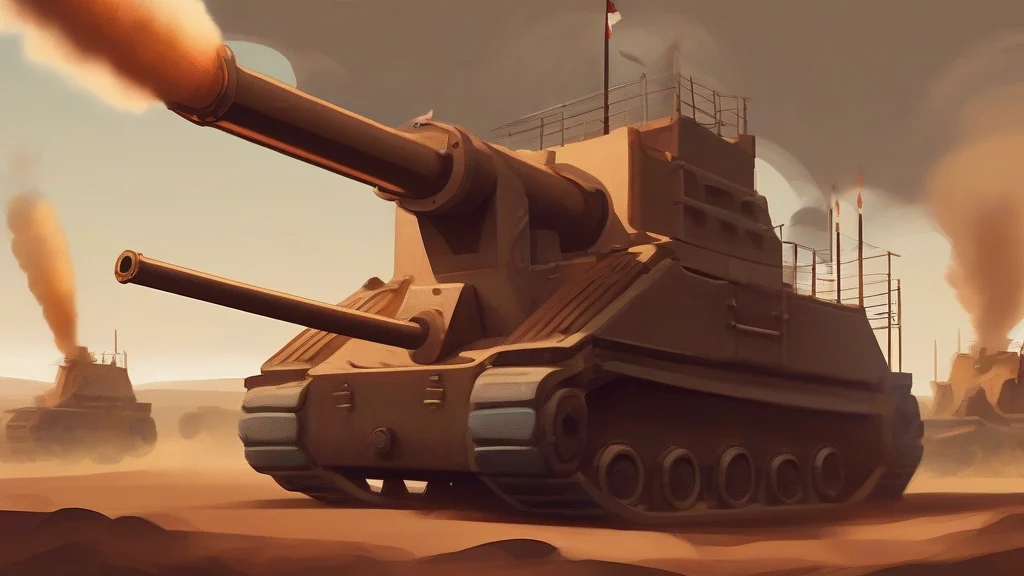
What does cannonry mean?
Cannonry is a collective noun referring to heavy artillery guns considered as a body, and by extension to their combined discharge in battle. Where a single gun is a cannon, the cannonry of an army or fleet is the whole massed array of such weapons, and phrases like "the enemy's cannonry" typically evoke the overwhelming thunder of many guns firing together. The word belongs chiefly to literary and historical registers: it appears in war narratives, accounts of sieges, and descriptive prose about Napoleonic or earlier warfare far more often than in modern technical military writing, which prefers terms like "artillery" or "fire support." Its connotations are dramatic rather than neutral — cannonry suggests noise, smoke, and the impersonal destructive power of massed ordnance. Related terms include cannonade (a sustained burst of gunfire) and cannoneer (a person who serves a cannon), making cannonry a useful word when describing warfare on a grand, atmospheric scale.
nounThe collective force or discharge of heavy artillery guns; also, cannons collectively as a body of armament.
- Heavy artillery guns collectively, especially as deployed by an army or navy.
- The firing or discharge of such guns; concentrated artillery fire.
"The hillside thundered under the enemy's cannonry."
"At dawn the fortress answered the besiegers' cannonry with volleys of its own."
"The novel's battle scenes are dominated by the deafening cannonry of the siege lines."
Rarely pluralized, since cannonry usually functions as a collective term; the plural appears only when treating separate bodies of artillery individually.
"The opposing cannonries fell silent at dusk."
Before 'cannon' entered English via French, its deepest ancestor was the Latin word for a hollow reed — so every cannon is, etymologically speaking, a very loud piece of bamboo.
Reviewed by Deb Chak, Editor. AI-assisted content curated by RJS Tech Solutions LLP.
Etymology of cannonry
Cannonry derives from cannon, a word English borrowed from Old French in the late Middle Ages. The further origin of cannon itself is debated, but it has long been connected to Latin canna, meaning a reed or tube — the same root that gives us cane and canal — fitting for a hollow-barreled weapon. The suffix -ry forms collectives denoting a class of things or practitioners, as in artillery-related groupings. A natural derivative, cannoneer, names the soldier who serves a cannon.
How cannonry is actually used
A literary and historical term, most at home in military history and descriptive prose about pre-modern warfare; it sounds formal or archaic in everyday speech.
Easily confused with cannonry
A cannery is a factory where food is canned and sealed in tins, whereas cannonry refers to large guns or their collective fire.
A cannonade is a continuous, sustained burst of artillery fire over time, while cannonry denotes the guns themselves or their fire more generally.