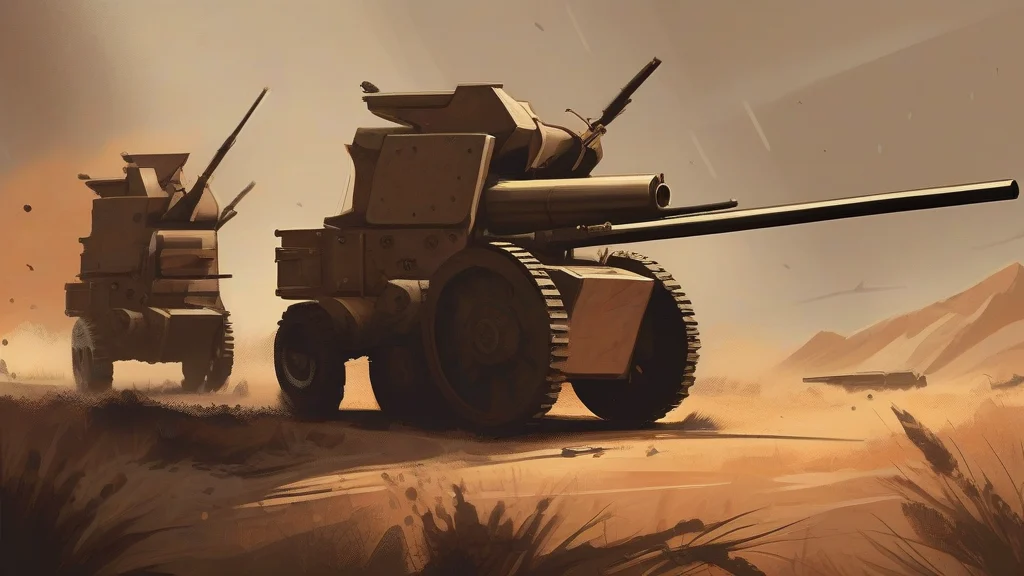
What does artillery mean?
Artillery refers to the large, heavy firearms of warfare — cannons, howitzers, mortars, and similar mounted guns capable of firing projectiles far beyond the range of handheld weapons. It also denotes the branch of an army trained to operate these weapons, as when a soldier serves in the artillery. The word functions chiefly as an uncountable collective noun: one speaks of heavy artillery or field artillery rather than counting individual pieces, though 'artillery piece' serves for a single weapon. In everyday speech, artillery can be applied figuratively to any powerful argument or resource brought to bear on a problem, as in deploying one's heaviest rhetorical artillery. The term evokes industrial-scale force and has long been central to descriptions of land warfare since the gunpowder era. Its blend of technical precision and metaphorical reach makes it equally at home in military history, news reporting, and persuasive writing.
Large-caliber mounted guns, such as cannons and howitzers, used to launch projectiles over long distances.
"Enemy artillery reduced the village to rubble within hours."
Usually uncountable; use 'artillery piece' when a single weapon must be counted.
The branch of an army responsible for operating heavy guns.
"He spent two decades in the artillery before retiring as a colonel."
Artillery has no plural form; as a collective noun it remains unchanged whether referring to one battery of guns or many. Individual weapons are counted separately using 'guns' or 'pieces of artillery'.
"Both armies massed their artillery along the ridge before dawn."
Before modern ballistics, 'artillery' didn't just mean guns — it covered any ingenious war machine, from giant crossbows to catapults, because the word traces back to the same Latin root as 'artisan'.
Reviewed by Deb Chak, Editor. AI-assisted content curated by RJS Tech Solutions LLP.
Etymology of artillery
Artillery entered English in the late Middle Ages via Old French 'artillerie', originally denoting any military equipment or engines of war, including catapults and siege machines. The word derives from 'artiller', meaning to equip or arm, rooted in notions of skill or craft — the same idea underlying Latin 'ars, artis' (skill, art). As gunpowder weapons came to dominate warfare by the early modern period, the term narrowed to mean heavy firearms specifically. It thus shares its distant root with words like 'art', 'artisan', and 'artifact', all reflecting the sense of skilled making.
Related word forms
How artillery is actually used
Artillery is typically treated as a collective noun and is usually uncountable when referring to the weapons themselves ('heavy artillery', not 'an artilleries'). When counting individual pieces, speakers say 'a gun' or 'an artillery piece'. In military contexts it also names the branch of service, often capitalized in official titles such as the Royal Artillery. The word carries a formal, technical register but appears freely in journalism and history writing.
Easily confused with artillery
An arsenal is a collection or storage place of weapons (or a stockpile of anything), while artillery specifically refers to large guns and the troops who operate them.
Armillary relates to armillary spheres (models of celestial objects), whereas artillery refers to large guns — the words merely resemble each other in sound.