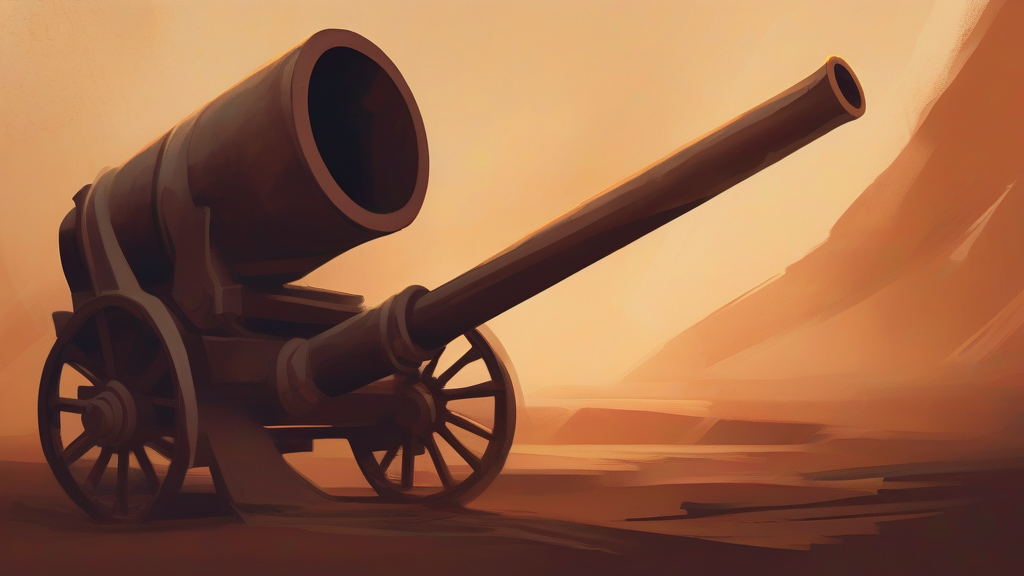
What does cannon mean?
A cannon is a large, heavy firearm mounted on a carriage, developed in Europe during the late Middle Ages and central to siege and naval warfare for centuries before being superseded by more modern artillery. The word refers both to the weapon itself and, by extension, to anything shaped or functioning like one. Beyond its literal military sense, 'cannon' has entered everyday language through memorable idioms: a 'loose cannon' describes someone whose unpredictable behavior endangers others, echoing the danger of an unsecured cannon rolling about a ship's deck, while 'cannon fodder' grimly denotes soldiers regarded as expendable. The word is standard in both British and American English and carries connotations of power, noise, and historical warfare rather than any single emotional tone. Its plural is normally 'cannons', though collective military usage sometimes leaves it unchanged.
A large, heavy gun, typically mounted on wheels or a carriage, that fires heavy projectiles such as iron balls or shells.
"Fort Henry's walls were lined with cannons aimed at the harbor."
The plural is usually 'cannons'; in older or collective military usage the plural form may be left unchanged.
(Chiefly British) To drive one billiard or snooker ball against another; also, more generally, to collide forcefully with something while moving.
"He cannoned off the cushion and potted the black."
This verb sense is primarily British and largely confined to cue sports contexts.
The regular plural 'cannons' is standard today. Historically, especially in naval and military writing, the plural was often left unchanged ('the ship mounted sixty cannon').
"The battlefield display featured three Civil War-era cannons."
The phrase 'loose cannon' comes straight from the age of sail, when a warship's unsecured cannon could roll across the deck in rough seas, crushing anyone in its path.
Reviewed by Deb Chak, Editor. AI-assisted content curated by RJS Tech Solutions LLP.
Etymology of cannon
The word 'cannon' derives from Old French 'canon', which itself traces back through Italian to the Late Latin 'canna', meaning a reed or tube. This Latin term was borrowed from the Greek 'kanna', also denoting a reed. The underlying idea is thus that of a hollow tube — fitting for a weapon that is essentially a metal barrel — and the same root gives English words such as 'cane', 'canal', and 'cannula'. The word entered English in the fourteenth century as artillery technology spread across Europe from the Mediterranean.
Related word forms
How cannon is actually used
As a noun of warfare, 'cannon' is neutral in register. In British English, 'cannon' also functions as a verb meaning to strike one billiard ball against another, and the plural may appear unchanged ('sixteen cannon'), though 'cannons' is now standard in most contexts. The figurative sense survives almost entirely in the fixed expression 'loose cannon'.
Easily confused with cannon
A canon is an official rule, principle, or list of accepted works (or a member of clergy), whereas a cannon is a large mounted gun.