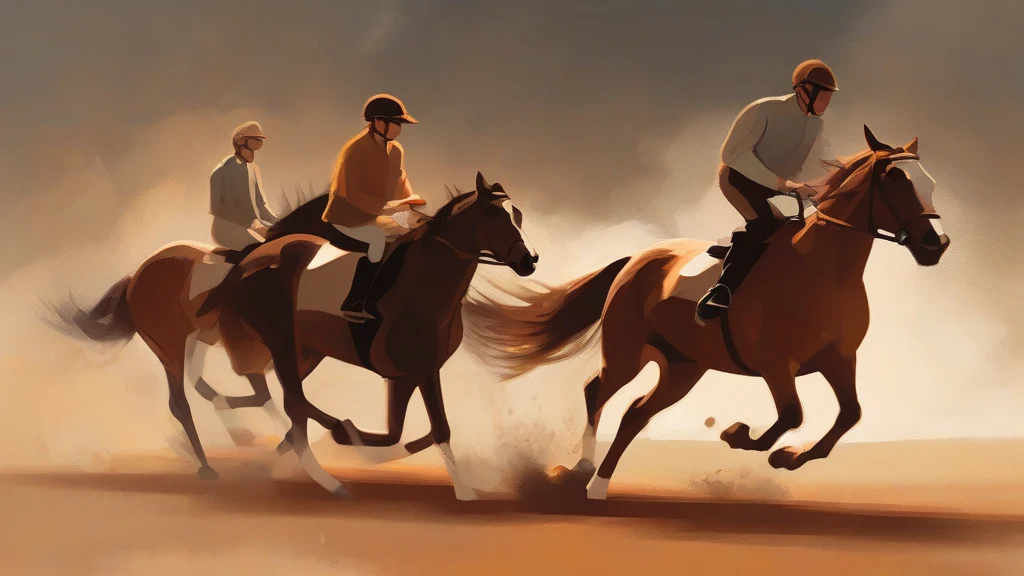
What does cantering mean?
Cantering is the act of riding — or being ridden — at a canter, the relaxed three-beat gait that sits between a trot and a full gallop. A horse that is cantering moves with a smooth, rocking rhythm, making it the pace riders typically choose for covering ground comfortably without exhausting either horse or rider. The term comes from the verb 'canter', which originated as a shortened form of 'Canterbury pace', a reference to the easy speed at which pilgrims rode their horses toward the shrine of Thomas Becket in medieval England. Today the word belongs chiefly to equestrian vocabulary, appearing constantly in riding instruction, horse racing commentary, and descriptions of country pursuits. It has also developed a mild figurative use: writers may say someone is 'cantering' through a task or toward a goal, suggesting effortless, unhurried progress. The connotations are almost entirely positive, evoking grace, confidence, and controlled freedom rather than haste or strain.
verbThe present participle of the verb 'to canter': to ride a horse at a smooth, easy three-beat gait that is faster than a trot but slower than a gallop.
- (Of a horse or rider) moving at a canter, the smooth three-beat gait between a trot and a gallop.
- (Figuratively) progressing in an easy, unhurried manner.
"The riders spent the morning cantering across the open moorland."
"They went cantering along the beach as the sun rose over the dunes."
"After weeks of steady work, the team was cantering toward the project deadline."
The word 'canter' is short for 'Canterbury pace' — it was named after the easy gait pilgrims' horses used on the road to Thomas Becket's shrine.
Reviewed by Deb Chak, Editor. AI-assisted content curated by RJS Tech Solutions LLP.
Etymology of cantering
Cantering derives from the verb 'canter', which emerged in English in the early 17th century as a colloquial abbreviation of 'Canterbury pace' or 'Canter-bury gallop'. This referred to the easy, moderate gait at which pilgrims customarily rode their horses on journeys to the shrine of St Thomas Becket at Canterbury Cathedral. The word thus carries a rare trace of medieval pilgrimage culture within modern equestrian vocabulary. Its only true lexical relative is the place name Canterbury itself, from Old English Cantwareburh, 'fortress of the Kentish people'.
Related word forms
How cantering is actually used
Register is neutral to slightly informal; the figurative sense ('cantering through') appears mainly in journalistic and conversational prose. The word almost always implies ease and control rather than urgency.
Easily confused with cantering
A cantor is a person who leads singing or chants in religious services, whereas cantering describes riding a horse at a moderate gait.