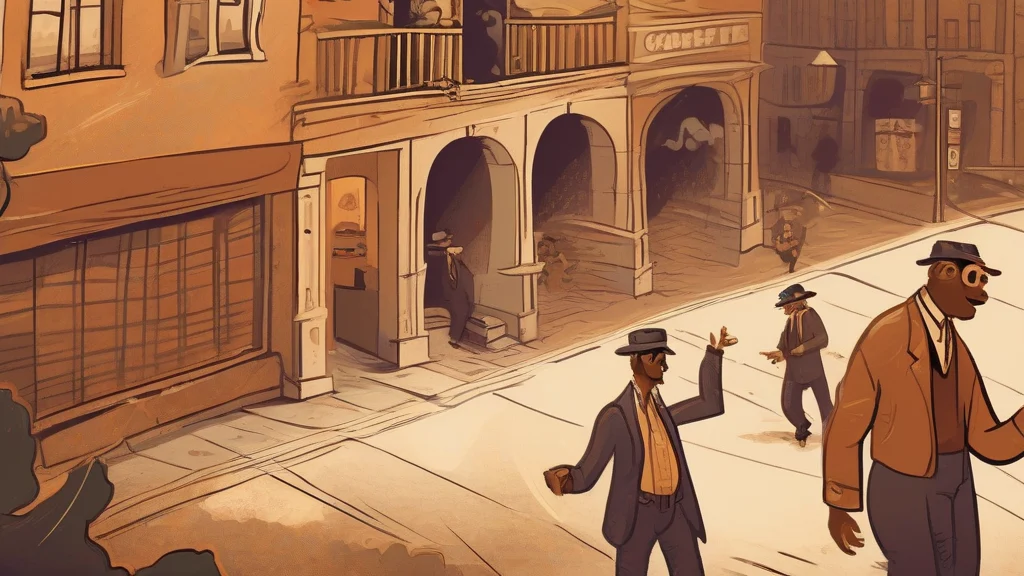
What does caper mean?
A caper is, most commonly, a lively, playful leap or skipping movement — the kind of bound a lamb, kitten, or delighted child might make when bursting with energy. By extension, the word describes any spirited escapade or prank, and in modern informal usage it often refers to an elaborate scheme or criminal adventure, as in a 'bank caper' or a 'caper film'. It also functions as a verb meaning to skip or prance about merrily. Entirely distinct in origin, though spelled identically, is the culinary caper: the small pickled flower bud of a Mediterranean shrub, prized for its salty tang in sauces and dishes like piccata and tartare. The movement sense derives ultimately from the Latin caper, meaning 'goat', evoking that animal's characteristic friskiness, which also gives English such relatives as 'capriole' and 'capricious'. In register, the word leans literary and lighthearted, carrying connotations of exuberance rather than seriousness, and it remains a vivid choice for describing joyful, unrestrained motion or mischievous adventure.
A playful leap or skipping movement; an energetic, frisky step.
"The foal startled everyone with a sudden caper across the field."
Frequently pluralized in older literary style, as in 'cutting capers'.
Informally, an amusing escapade, prank, or adventurous undertaking, especially an elaborate criminal scheme or heist.
"The novel recounts a daring caper involving three retired safecrackers."
To skip, leap, or dance about in a playful or high-spirited manner.
"Children capered around the maypole on the village green."
Usually used with adverbial phrases such as 'about' or 'around'.
The small flower bud of the caper bush (Capparis spinosa), pickled in brine or vinegar and used as a sharp, salty condiment.
"She garnished the smoked salmon with capers, lemon zest, and dill."
Almost always used in the plural in culinary contexts; etymologically unrelated to the movement senses.
In the 'antics' sense, the plural 'capers' is idiomatic in the fixed phrase 'cut capers', meaning to behave playfully or show off. In cookery, 'capers' is nearly always plural because the buds are served many at a time.
"The comedian spent the evening cutting capers until the whole room was laughing."
The playful 'caper' and the tangy pickled 'caper' on your plate come from completely different roots — one from the Latin word for 'goat', the other from ancient Greek.
Reviewed by Deb Chak, Editor. AI-assisted content curated by RJS Tech Solutions LLP.
Etymology of caper
The playful senses of caper trace back through Middle French and early modern English to the Latin caper, meaning 'goat', which also yields the related words caprine, capriole, and capricious. English adopted the word in its leaping sense by the late sixteenth century, with the 'escapade' and later 'criminal scheme' senses developing naturally from the image of high-spirited bounds. The pickled-bud caper has a wholly separate ancestry, descending from Latin capparis and Greek kapparis, so the two homonyms share nothing but their spelling.
Related word forms
How caper is actually used
The verb and the 'antics' sense carry a light, cheerful, often childlike connotation, and appear frequently in literary descriptions of animals and children at play. The 'heist' sense is informal but well established in journalism and film criticism ('a caper movie'). Note that this word is entirely unrelated in origin to the culinary caper, though the identical spelling means context always determines which sense applies.