What does caracole mean?
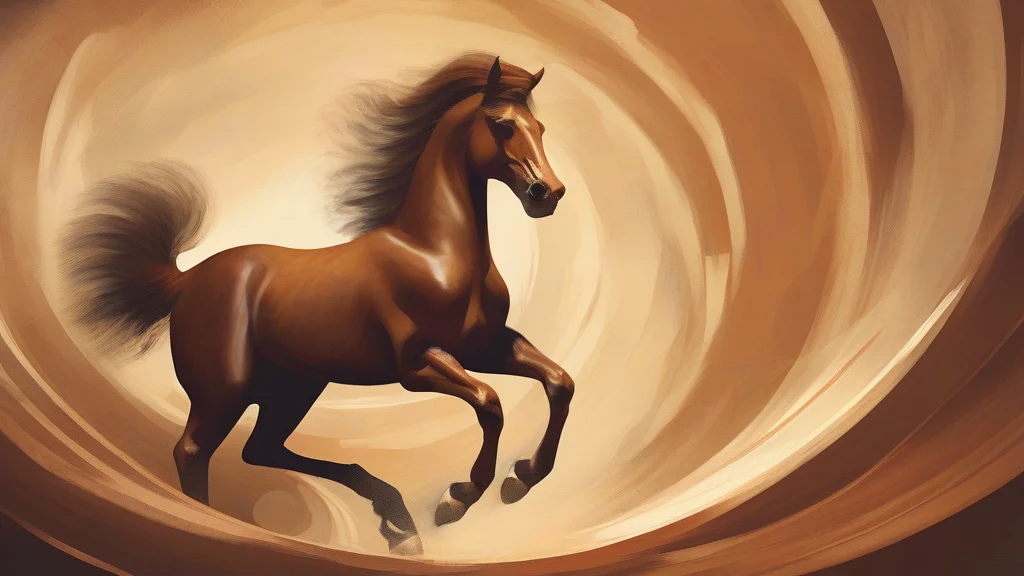
A caracole is a half-turn executed by a trained horse, a manoeuvre central to the elaborate riding displays of Renaissance and early modern Europe. The term derives ultimately from the Spanish 'caracol', meaning 'snail', a nod to the small spiral path the animal's hooves trace during the turn. Historically, the caracole was a genuine battlefield tactic: massed cavalry would advance on infantry, discharge their pistols at close range, and then wheel away to reform — a rotating volley-fire technique that defined sixteenth- and seventeenth-century mounted warfare. Today the word survives mainly in the vocabulary of classical dressage, where schools such as Vienna's Spanish Riding School still teach precise half-turns to breeds like the Lipizzaner, and in literary prose describing elegant or winding movement. By extension, writers occasionally use 'caracole' figuratively for any graceful spiral motion. It remains a specialised, somewhat archaic term, prized more for its picturesque history than its currency in ordinary speech.
A half-turn made by a trained horse, especially in dressage or historic cavalry manoeuvres; also, a winding spiral movement suggestive of a snail's shell.
"The rider brought the bay mare around in a tight caracole, her hooves describing a neat half-circle in the sand."
Most commonly found in historical writing about cavalry tactics or in descriptions of classical dressage performances.
To perform a half-turn on horseback; to wheel about or move in a spiralling manner.
"The troopers caracoled sharply to the right, presenting their pistols to the advancing pike line."
The verb is considerably less common than the noun and appears almost exclusively in literary or historical contexts.
Standard pluralisation applies; used when referring to multiple turns or multiple instances of the manoeuvre.
"The quadrille demanded a sequence of perfectly synchronised caracoles from all four riders."
The word 'caracole' literally comes from the Spanish for 'snail' — because a horse performing one traces a tiny spiral, like a shell.
Reviewed by Deb Chak, Editor. AI-assisted content curated by RJS Tech Solutions LLP.
Etymology of caracole
The word enters English in the late sixteenth century, borrowed from French 'caracole', which itself derives from Spanish 'caracol', meaning 'snail' or 'spiral shell' (and, by extension, a spiral staircase). The Spanish term likely traces back further, possibly via Latin or a pre-Roman Iberian source, though the ultimate origin is uncertain. The equestrian sense arose because the horse's turning path resembles a snail's coiled shell, and cognate forms appear in other Romance languages with related meanings involving shells or spiral shapes.
Related word forms
How caracole is actually used
The noun is now chiefly encountered in historical or equestrian contexts — descriptions of Renaissance cavalry tactics, classical dressage, or baroque horsemanship schools like the Spanish Riding School. The verb form is rarer and mostly literary. The word carries an air of elegance and antiquarian charm rather than everyday utility.
Easily confused with caracole
A carousel is a revolving merry-go-round or a circular riding display, while a caracole is a single half-turn made by a horse.
The caracal is a wild cat native to Africa and Asia, unrelated to the equestrian manoeuvre called a caracole despite the similar spelling.