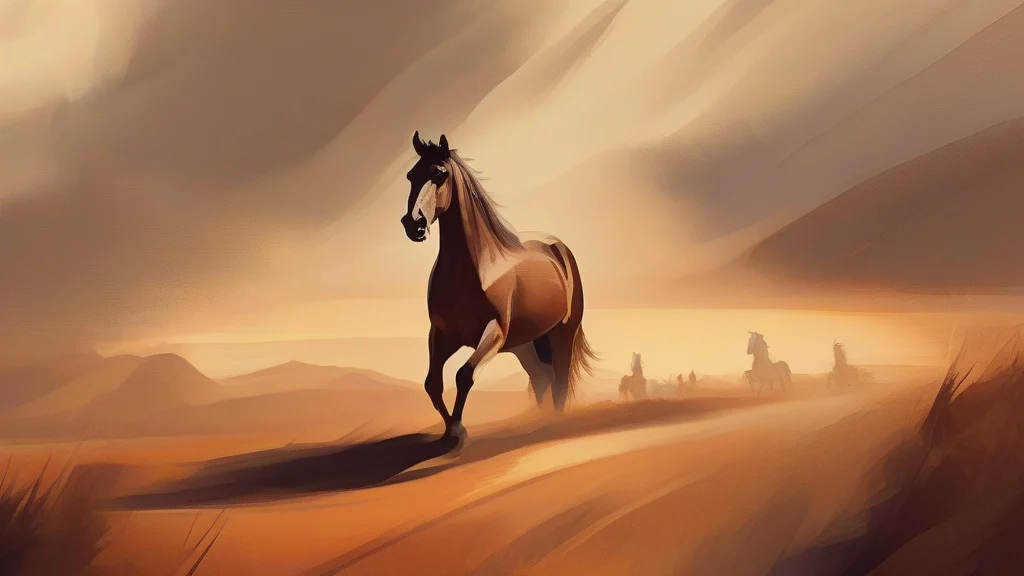
What does caracoling mean?
To caracole is, in its original and literal sense, a riding term: it describes a horse performing a series of quick half-turns or curvets to the left and right as it moves forward, a manoeuvre prized in Renaissance and early modern cavalry drill and still seen in classical dressage and ceremonial display. The word derives from the Spanish 'caracol', meaning a snail or spiral shell, a nod to the coiling path the horse traces. By extension, 'caracoling' has acquired a figurative use, describing people who move, dance, speak, or conduct their affairs in a showy, winding, or deliberately indirect fashion — someone might caracole around an awkward question rather than answer it plainly. Today the word is largely literary, lending colour to descriptions of horsemanship, pageantry, or evasive behaviour, and carries a slightly archaic, elegant connotation.
verbTo caracole is (of a horse) to make half-turns to left and right while moving forward, or (figuratively) to move or act in a showy, evasive, or roundabout manner.
- (Of a horse) to execute successive half-turns or curvets while advancing — a trained equestrian manoeuvre.
- (Figurative) to move, speak, or behave in a showy, winding, or evasively indirect way.
"The Andalusian stallion caracoling across the parade ground drew gasps from the crowd."
"The cavalrymen were drilling their mounts, caracoling in perfect formation before the reviewing stand."
"In her speech she kept caracoling around the question, never giving a straight answer."
When a horse 'caracoles,' it's tracing its name back to a snail — Spanish 'caracol' literally means snail shell, and the spiralling turns of a caracoling horse echo that coiling shape.
Reviewed by Deb Chak, Editor. AI-assisted content curated by RJS Tech Solutions LLP.
Etymology of caracoling
The word comes from the French 'caracole' (a horse's half-turn), borrowed from Spanish 'caracol', which denotes both a snail and a spiral shell, ultimately from a Late Latin/Greek-derived term related to coiled shells. It entered English in the late sixteenth century alongside the military manoeuvre of the same name, in which mounted troopers wheeled their horses to fire pistols and retire. Cognates survive in Spanish and French with the same equestrian and shell-related senses.
Related word forms
How caracoling is actually used
Primarily literary and historical in register today; the literal equestrian sense appears mostly in writing about classical horsemanship, cavalry history, and Renaissance warfare, while the figurative sense is used for playful or evasive verbal and physical manoeuvring.
Easily confused with caracoling
Caricaturing means mocking by exaggeration of features, whereas caracoling describes a horse's half-turning movement or figurative evasive maneuvering.