
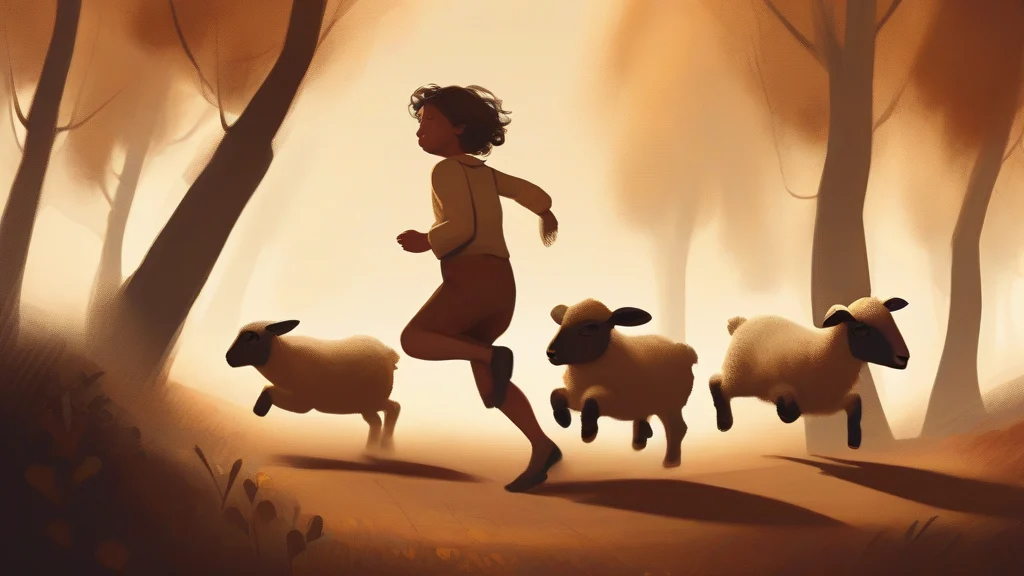
What does gambolling mean?
Gambolling means running, jumping, and skipping about in a playful, high-spirited way — the kind of exuberant motion seen in lambs in a spring meadow, puppies at play, or delighted children. The verb conveys unselfconscious joy and boundless energy, and it carries a warm, almost pastoral connotation that has made it a favourite of nature writers and poets describing idyllic countryside scenes. Though somewhat old-fashioned in flavour, it remains in regular use, particularly in British writing, where it is spelled with a double 'l'; American usage generally favours the spelling 'gamboling'. The word derives from the French 'gambade', meaning a leap or bound, making it an etymological cousin of 'gamble' — a striking example of two meanings diverging from a shared root. As a noun, a 'gambol' refers to a single act of such frolicking. For anyone describing youthful exuberance, animal playfulness, or carefree delight, few words capture the mood as vividly.
To run, jump, and skip about playfully and energetically; to frolic or frisk in a lighthearted manner.
"Foals were gambolling in the paddock, kicking up their heels in the evening light."
In this sense 'gambolling' functions as a present participle; British spelling uses 'll', while US spelling typically uses 'gamboling'.
An act or spell of playful leaping and frisking about.
"The kittens' gambols kept the household entertained all afternoon."
The plain form 'gambol' is more commonly used for the noun sense than 'gambolling'.
The word for a lamb's joyful leaping is, believe it or not, a sibling of the word 'gamble' — both trace back to the same French term, yet one means carefree fun and the other a wager.
Reviewed by Deb Chak, Editor. AI-assisted content curated by RJS Tech Solutions LLP.
Etymology of gambolling
Gambolling traces back through Old French 'gambader' and 'gambade', meaning a leap or bound of a horse, ultimately derived from Latin 'gamba', meaning leg or shank — the same root that gives its name to the anatomical term 'gambrel'. The English word 'gambol' emerged in the early decades of the seventeenth century, borrowed from the French notion of capering or frisking. Its close relative 'gamble' developed separately from related Romance vocabulary concerning games, so the two modern words, despite their similar sound and shared linguistic ancestry, came to describe entirely different activities.
Related word forms
How gambolling is actually used
'Gambolling' is spelled with double 'll' in British English; American English typically uses 'gamboling'. The word carries a warm, wholesome connotation and appears most often in pastoral, nature, or nostalgic writing rather than formal prose. It is somewhat old-fashioned but remains common in descriptions of springtime countryside scenes.
Easily confused with gambolling
'Gambling' means betting or playing games of chance for money, whereas 'gambolling' means playful skipping and leaping about; the words share an etymological root but have entirely unrelated meanings today.