What does caravan mean?
A caravan is a group of travellers or vehicles making a journey together, most famously the camel trains that crossed desert routes linking trading cities for centuries. The word also has a distinct British meaning: a wheeled vehicle towed behind a car and fitted out for living in on holiday, what Americans would call a trailer. This gives the word two lively modern contexts — historical accounts of merchant expeditions, and the very British pastime of touring the countryside with one's mobile home in tow. Derived terms such as 'caravanning' and 'caravan park' belong almost entirely to British usage. Connotations vary accordingly: evocative of adventure and commerce in one register, of modest seaside holidays in another. The word entered English in the sixteenth century from Persian via Turkish and Arabic, reflecting the trade networks along which it travelled.
A company of travellers or vehicles journeying together, especially across desert or sparsely inhabited country.
"The silk merchants set out with a caravan of forty camels."
This is the dominant sense in both British and American English.
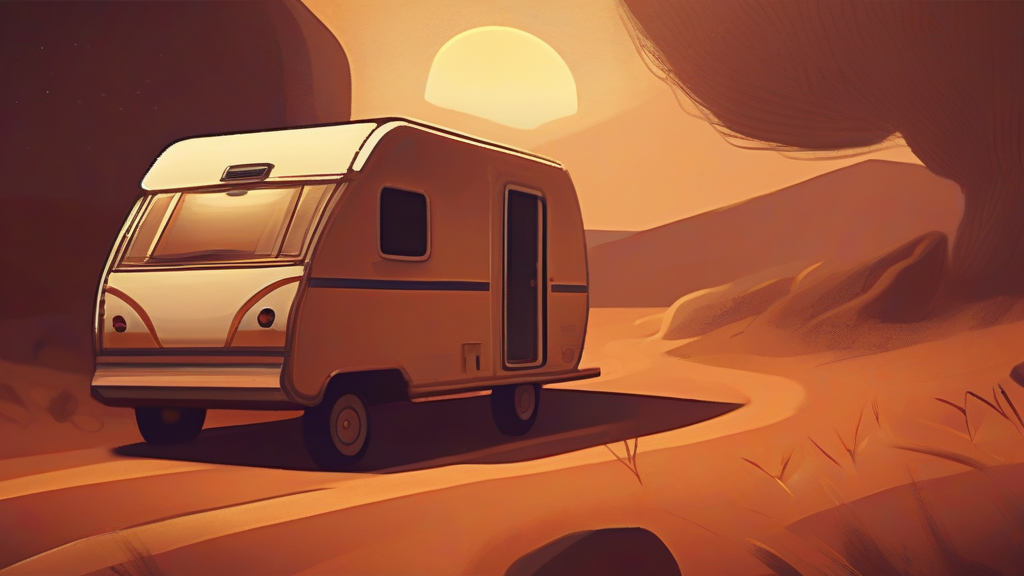
(British English) A covered vehicle towed behind a car and equipped for living in, used especially for holidays.
"They parked their caravan beside the sea at Whitstable."
American speakers use 'trailer' or 'RV' instead; this sense is largely confined to Britain.
(British English) To travel or holiday with a caravan.
"The family spent August caravanning around Cornwall."
Regular plural, used for both the travelling-group sense and the towed-vehicle sense.
"Several caravans were strung out along the mountain pass."
The word 'caravan' travelled further than most of its travellers — it journeyed from Persian trade routes through Turkish and Arabic before reaching English in the 16th century.
Reviewed by Deb Chak, Editor. AI-assisted content curated by RJS Tech Solutions LLP.
Etymology of caravan
The word comes from Persian kārvān, meaning a company of travellers, and reached English in the sixteenth century through Turkish kervan and Arabic qārwān, reflecting the great overland trade routes of Asia and North Africa. The closely related 'caravanserai', from Persian, denotes the roadside inns built to shelter such travelling groups. The British sense of a towed living vehicle developed later, in the nineteenth and twentieth centuries.
Related word forms
How caravan is actually used
In British English 'caravan' commonly refers to the towed holiday home, and related terms like 'caravanning' are everyday words; American English uses 'trailer' or 'RV' for this sense and reserves 'caravan' chiefly for the travelling-group meaning. The plural 'caravans' is standard in all senses.
Easily confused with caravan
A caravanserai is an inn or resting place for travellers and their caravans, whereas a caravan is the group of travellers or the vehicles themselves.