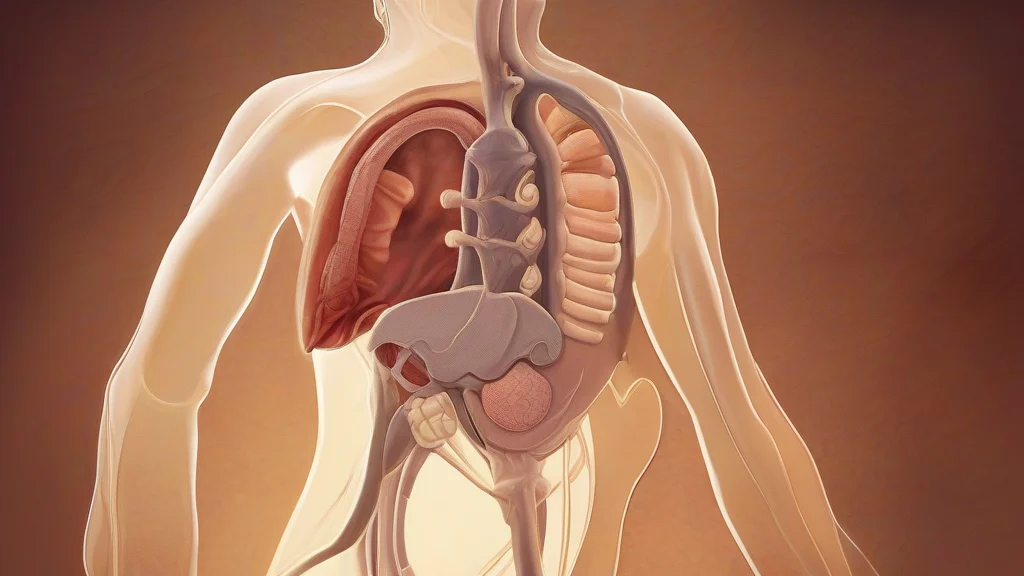
What does cardia mean?
In anatomy, the cardia is the point at which the oesophagus opens into the stomach, encircled by the lower oesophageal sphincter, which acts as a valve preventing stomach acid from travelling back up the food pipe. By extension, the term also names the small upper portion of the stomach that surrounds this junction. The word comes from the Greek kardia, meaning 'heart': early anatomists applied it here either because the region lies near the heart or because the sphincter was thought to open and close like a heart's valves, a naming habit that also survives in 'cardiac' meaning relating to the heart. Today the cardia appears mainly in medical contexts — descriptions of reflux disease, endoscopy reports, and discussions of gastro-oesophageal tumours — so it is a precise, formal term rather than a word of everyday conversation. Knowing it helps make sense of clinical language about the stomach's upper entrance.
nounThe cardia is the anatomical term for the opening of the oesophagus into the stomach, and by extension the upper region of the stomach surrounding that junction.
- The opening of the oesophagus into the stomach, guarded by the lower oesophageal sphincter.
- The part of the stomach immediately surrounding this opening.
"The endoscopist noted mild inflammation at the cardia, just where the oesophagus meets the stomach."
"A hiatal hernia can weaken the cardia, allowing acid to reflux into the oesophagus."
"Tumours arising at the cardia are classified separately because of their distinctive clinical behaviour."
Rarely used, since each human body has only one cardia; the anglicised plural 'cardias' is preferred over the Latin-style 'cardiae' in modern medical texts.
"Comparative studies have examined differences between the cardias of various mammalian species."
Your heart gave your stomach its name for its entrance — the ancient Greeks thought the cardia sat close enough to the heart to be called its 'mouth.'
Reviewed by Deb Chak, Editor. AI-assisted content curated by RJS Tech Solutions LLP.
Etymology of cardia
Cardia derives directly from Greek kardia, meaning 'heart', which ancient anatomists used to label the stomach's oesophageal opening — likely because of its proximity to the heart or an imagined resemblance to the cardiac valves. The term passed through New Latin into English medical vocabulary during the early modern period as anatomy adopted Greek nomenclature. It belongs to a large family of learned borrowings from the same root, including pericardium, myocardium, cardiology, and electrocardiogram, all of which trace back to that single Greek word for the heart.
Related word forms
How cardia is actually used
A technical term used in anatomy, gastroenterology, and pathology rather than everyday speech; it is always singular and normally takes the definite article ('the cardia'). The adjective 'cardiac' derives from the same Greek root but usually refers to the heart in general usage.
Easily confused with cardia
There is no standard English word 'chordia'; the similar-sounding 'chorda' denotes a cord-like anatomical structure, whereas cardia specifically refers to the oesophageal opening of the stomach.