
What does carriage mean?
A carriage is a wheeled vehicle used to transport people, most classically a horse-drawn conveyance — often an elegant, enclosed one associated with formal occasions, royalty, or historical life before the automobile. The word extends naturally into other domains: in British English a railway carriage is a passenger coach on a train, and in mechanical contexts a carriage is the moving part of a machine that carries another component, as in the carriage of a typewriter. In older and chiefly British commercial language, carriage also denotes the transporting of goods or the charge made for doing so, surviving in phrases like 'postage and carriage.' The word carries connotations of ceremony, refinement, and a bygone era, which is why it persists in wedding processions, heritage tourism, and fairy-tale imagery. Whether describing a gilded state coach, a first-class train compartment, or a printer's sliding mechanism, carriage consistently evokes the idea of something being borne along.
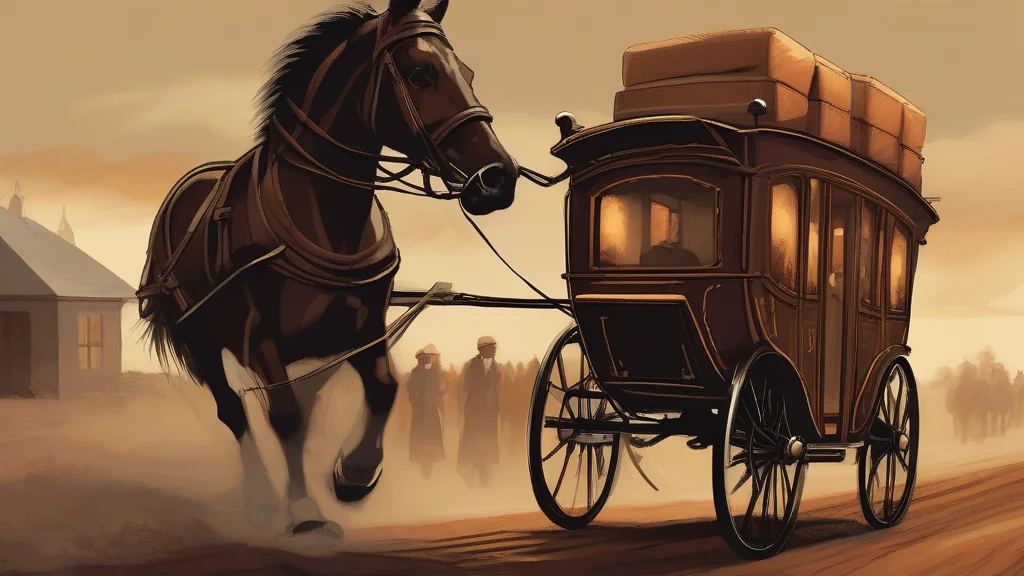
A horse-drawn wheeled vehicle for carrying people.
"They arrived at the ball in a horse-drawn carriage."
A railway passenger coach (British).
"Her seat was in the quiet carriage at the front of the train."
Chiefly British; American English uses 'car' or 'coach' instead.
The moving part of a machine that carries another component, e.g. of a typewriter or printer.
"The typewriter carriage slid back with a cheerful ding at the end of each line."
The transport of goods, or the charge for doing so (chiefly British, commercial).
"The price includes postage and carriage."
Now mostly found in commercial contexts.
Standard regular plural; used for multiple vehicles, coaches, or machines' components.
"The museum displays several restored Victorian carriages."
The phrase 'carriage return' on your keyboard is a fossil from typewriters — when you hit Enter, you were once literally returning a metal carriage to the start of a new line.
Reviewed by Deb Chak, Editor. AI-assisted content curated by RJS Tech Solutions LLP.
Etymology of carriage
Carriage entered English in the late Middle English period, derived from the verb carry, which itself came from Anglo-Norman carier, ultimately from Late Latin carricare, meaning 'to load onto a cart,' formed on Latin carrus, a Gallic-type four-wheeled wagon. The suffix -age marks it as a noun of action or result, so carriage originally denoted the act or cost of carrying before narrowing to mean the vehicle itself. It shares its ultimate root with words like carrier, cargo, and career (originally 'a road or course').
How carriage is actually used
In British English 'carriage' commonly refers to a railway passenger coach; in American English this sense is rare, with 'coach' or 'car' preferred. The baby-carriage sense is chiefly North American (British: pram/pushchair). The shipping-cost sense ('postage and carriage') is now largely commercial British usage.
Easily confused with carriage
A carrier is a person or thing that carries or transports something, while a carriage is typically a vehicle for passengers.