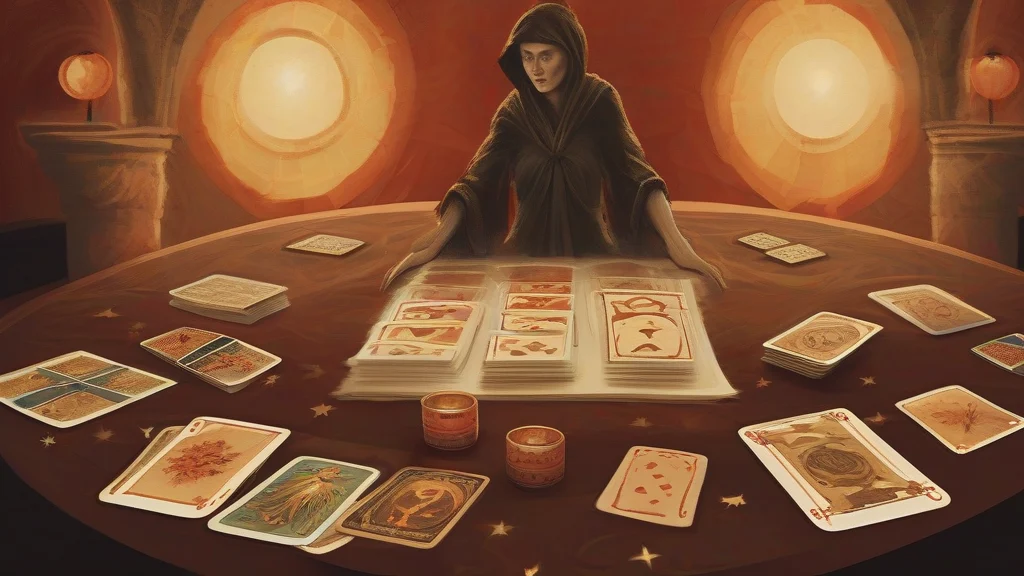
What does cartomancy mean?
Cartomancy is the practice of fortune-telling by means of cards. A practitioner, known as a cartomancer, lays out a selection of cards in a pattern called a spread and interprets their meanings — traditionally using ordinary fifty-two-card playing decks, though modern readers frequently employ tarot cards instead. Each suit, rank, or arcana carries symbolic associations, which the reader weaves into an account of the sitter's past circumstances or future prospects. The word derives from the Latin 'charta' (paper or card) combined with the Greek 'manteia' (divination), making it a cousin of terms such as cartography, chiromancy, and necromancy. Cartomancy flourished from the eighteenth century onward, when playing cards became widely available and interest in the occult grew across Europe. Today the word appears chiefly in historical, folkloric, and esoteric contexts, lending a slightly formal or antiquarian tone; in everyday speech people are more likely simply to mention having 'their cards read'.
nounFortune-telling by means of cards, especially the interpretation of a spread of playing or tarot cards to divine future events or reveal hidden knowledge.
- The practice of divining the future or gaining hidden insight by interpreting cards, most often standard playing-card decks or tarot decks.
"Her grandmother practised cartomancy at village fairs, laying out the cards and reading each visitor's fortune."
"She turned to cartomancy only once a year, on her birthday, when the cards felt most likely to speak clearly."
"The novel's heroine earns her living through cartomancy, though she secretly doubts the cards can see anything at all."
Rarely used in the plural; the noun is almost always treated as uncountable since it names a practice. A plural form exists grammatically but would appear only in unusual contexts, such as distinguishing different systems or traditions of card-reading.
"The book surveys the various cartomancies of nineteenth-century Europe, from Lenormand-style spreads to tarot."
The same ancient root that gives us 'map' also gives us fortune-telling — because for centuries, an ordinary deck of playing cards was believed to hold your future.
Reviewed by Deb Chak, Editor. AI-assisted content curated by RJS Tech Solutions LLP.
Etymology of cartomancy
Cartomancy entered English in the nineteenth century, borrowed from French 'cartomancie', a compound joining 'carte' (card) to 'mancie' (divination). The first element traces back to Latin 'charta' and Greek 'chartēs', meaning a sheet of papyrus or paper — the same root that gives English 'card', 'carton', and 'cartography'. The second element comes from Greek 'manteia', meaning divination or prophecy, which appears in a whole family of divinatory terms such as necromancy, chiromancy, and oneiromancy. The word thus literally means 'divination by cards'.
Related word forms
How cartomancy is actually used
A relatively formal or literary term; everyday speakers more often say 'reading cards', 'tarot', or 'fortune-telling'. It is uncountable in its main sense, referring to the practice as a whole. The word carries a neutral-to-slightly-mystical connotation and is common in writing about occultism, folklore, and history rather than casual conversation.
Easily confused with cartomancy
Cartography is the science of map-making, while cartomancy is fortune-telling with cards; both share the same root meaning 'paper' or 'chart'.