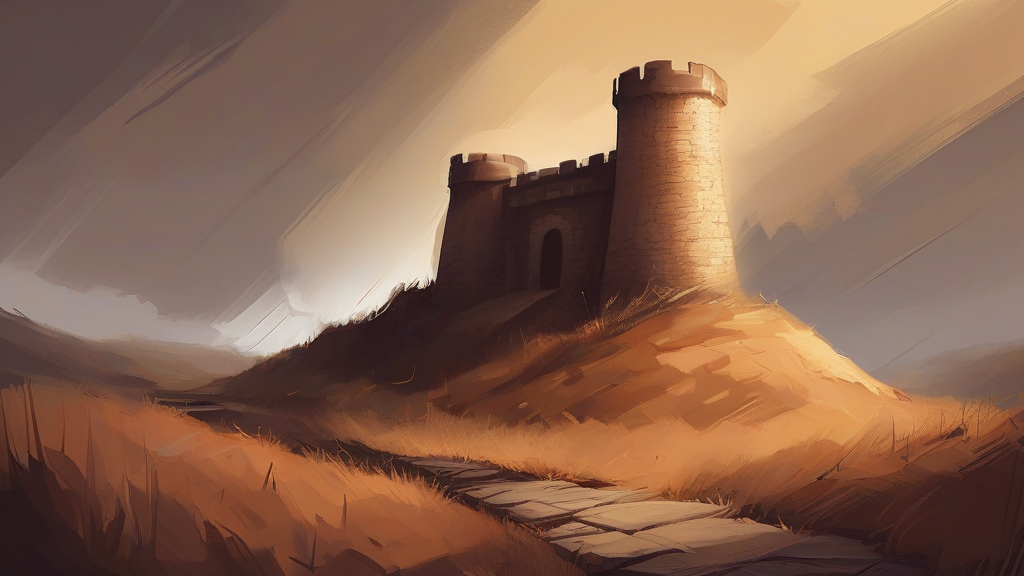
What does casemate mean?
A casemate is a protected chamber built into a fortification or a warship, designed to house guns while shielding them and their crews from enemy fire. In land fortresses, casemates are typically vaulted rooms set into thick walls or earthworks, with guns firing through narrow openings called embrasures. At sea, the term describes armoured housings along a ship's hull or superstructure in which guns are mounted. The word belongs chiefly to military and architectural vocabulary: it turns up in histories of siege warfare, descriptions of surviving bastion forts such as those at Vauban's French strongholds or America's coastal defences, and technical accounts of early twentieth-century battleships. Because casemated guns are fixed in position rather than mounted on rotating turrets, the word also carries a specific technical meaning when distinguishing older naval gun arrangements from later turret designs. For readers exploring forts, battlefields, or naval history, casemate names the sturdy, often brick-vaulted spaces where artillery was once housed and served.
nounA fortified chamber or enclosure within a fortress or ship, especially one from which guns are fired through an opening in a wall or armour plating; also, the armoured housing protecting a gun emplacement.
- A protected chamber in a fortification from which guns are fired through an embrasure or opening.
- An armoured structure or housing on a warship or land installation that protects a gun mount.
"The soldiers manned the casemate along the fortress wall as enemy fire intensified."
"Visitors can still explore the brick casemates built into the ramparts of the nineteenth-century coastal fort."
"The battleship's secondary guns were mounted in armoured casemates along the hull's side."
Standard English plural; used both for multiple chambers within a single fortification and for gun housings across a fleet.
"The fort's seaward face bristled with two tiers of casemates."
Despite ending in '-mate', the word has nothing to do with friendship — it comes straight from Italian for a 'house of safety', and it once sheltered cannon rather than companions.
Reviewed by Deb Chak, Editor. AI-assisted content curated by RJS Tech Solutions LLP.
Etymology of casemate
Casemate entered English in the seventeenth century, borrowed from French casemate, which itself derives from Italian casamatta. The Italian term combines casa, meaning 'house', with matta — a element whose precise origin is debated but which has been associated with words for 'mat' or 'padded covering'. The word thus literally suggests a 'covered' or 'protected house'. It spread through European military vocabulary during the era of trace italienne fortifications, when purpose-built gun chambers became a standard feature of fortress design.
How casemate is actually used
Casemate is primarily a technical term used in military history, architecture, and naval contexts. It carries no figurative or informal usage and appears almost exclusively in writing about fortifications, warships, and historic sites. The plural is casemates.
Easily confused with casemate
A casement is a window that opens on hinges at the side, while a casemate is a fortified gun chamber in a military structure.