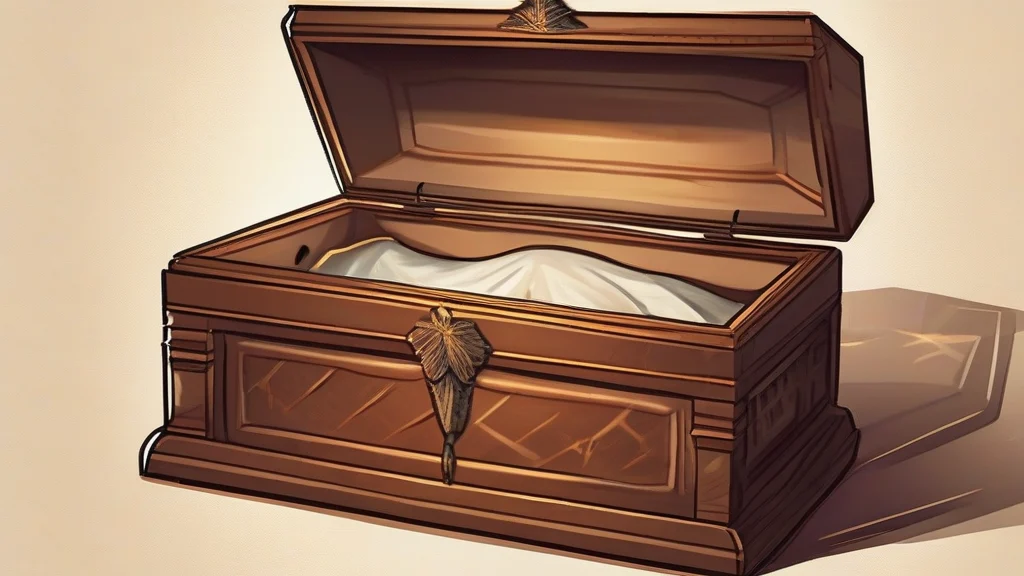
What does casket mean?
A casket is, in its oldest and most international sense, a small decorative box or chest used to store precious items such as jewellery, letters, or keepsakes — often finely crafted from wood or metal and lined with velvet. In North America, however, the word has taken on a second, far more common meaning: a coffin, particularly one that is polished, upholstered, and displayed at funerals. This funeral usage arose as a euphemistic alternative to "coffin," lending the word a solemn, respectful tone. The two senses are related by the idea of a container that holds something valued or revered. Outside North America, listeners may be puzzled if "casket" is used to mean a coffin, so context matters. Whether describing a jewelled reliquary in a museum or a burial vessel at a service, "casket" consistently suggests care, dignity, and craftsmanship in the containment of something treasured.
nounA small ornamental box or chest for holding jewels, letters, or other valuables; in North America, also a coffin.
- A coffin, especially one that is elaborately decorated (chiefly North American).
- A small ornamental box or chest for jewels, letters, or other valuables.
"She kept her grandmother's rings in a velvet-lined casket on the dressing table."
"The family chose a polished mahogany casket for the service."
"Among the relics was a small silver casket said to have held the saint's letters."
Regular plural, formed simply by adding -s.
"The workshop crafts several caskets each week to meet demand."
"Casket" originally meant a little treasure chest — the funeral meaning only took hold in 19th-century North America, as a gentler euphemism for "coffin."
Reviewed by Deb Chak, Editor. AI-assisted content curated by RJS Tech Solutions LLP.
Etymology of casket
Casket entered English in the late Middle Ages (attested from around the mid-15th century) meaning a small box or chest for valuables. It derives from Anglo-Norman and Old French "cassette," the diminutive of "casse" (box), which ultimately traces back through Italian "cassetta" and Latin "capsa" (a box or case) — the same root that gives us "case" and "chase" in the bookbinding sense. The North American funeral sense developed in the 19th century as a euphemism for "coffin," possibly influenced by the older poetic image of the body as a treasure committed to the grave.
How casket is actually used
In British English "casket" almost always means the small ornamental box; the coffin sense is chiefly American and Canadian. The coffin sense is a euphemism considered softer or more dignified than "coffin," though some find it overly sentimental. The word carries formal, ceremonial connotations in either sense.
Easily confused with casket
A basket is an open woven container, while a casket is a closed, often ornamental box (or, in North America, a coffin).
A cask is a large barrel for storing liquids, whereas a casket is a small decorative box or a coffin.