What does cassava mean?
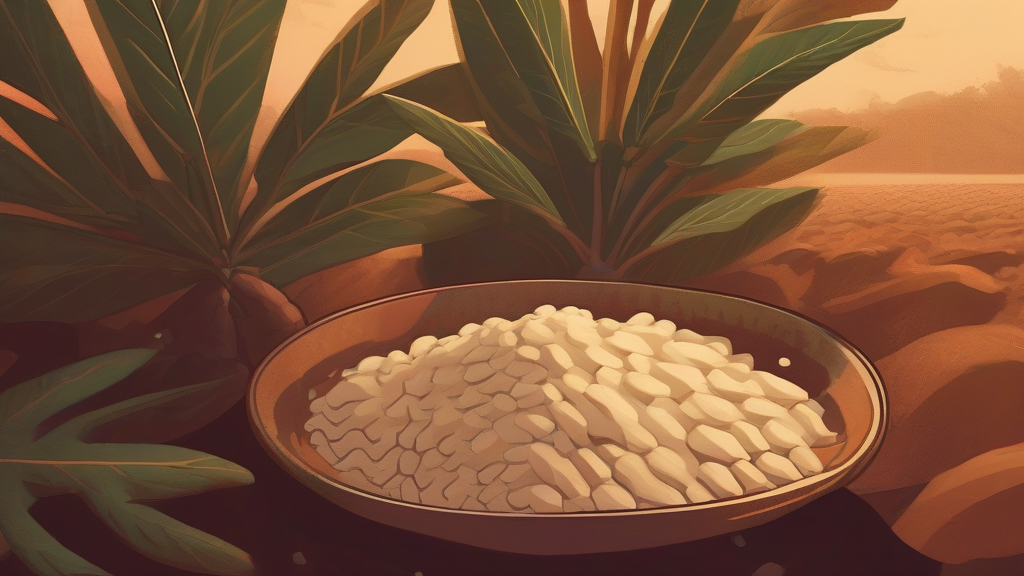
Cassava is a woody tropical shrub of the spurge family, widely cultivated for its large, starchy tuberous roots, which rank among the most important sources of dietary carbohydrate in Africa, South America, Southeast Asia, and the Pacific. The word refers both to the plant itself and to the edible root it produces, which must be peeled and cooked — and, in bitter varieties, carefully processed — to remove naturally occurring toxic compounds before eating. Cassava is remarkably drought-tolerant and grows in poor soils where other staples fail, making it a crucial food-security crop for smallholder farmers. It appears in everyday speech mainly through foods derived from it, such as cassava flour, cassava bread, and tapioca, which is extracted from its starch. The term is neutral in register, appearing freely in cookery writing, agriculture, and nutrition discussions alike.
nounA tropical shrub (Manihot esculenta) of the spurge family, cultivated for its large starchy tuberous roots, which are a major food source in many parts of the tropics. Also refers to the edible root itself.
- The tropical shrub Manihot esculenta, grown for its starchy tuberous roots.
- The starchy edible root of this plant, used as a staple food and processed into products such as tapioca and cassava flour.
"The farmers harvested the cassava and ground its roots into flour for the village market."
"Cassava is a staple crop across much of West Africa, where its roots are boiled, fried, or fermented into traditional dishes."
"The bakery now uses cassava flour in place of wheat to make gluten-free bread."
Used when counting the plants or individual roots. When referring to the substance or foodstuff generally, 'cassava' is uncountable.
"She bought three fresh cassavas at the market."
Cassava feeds hundreds of millions of people across the tropics — but eaten raw or improperly prepared, its roots can release toxic cyanide compounds, which is why careful processing has shaped entire cuisines.
Reviewed by Deb Chak, Editor. AI-assisted content curated by RJS Tech Solutions LLP.
Etymology of cassava
The word 'cassava' entered English in the mid-16th century, borrowed through Spanish and Portuguese from the Taíno language of the Caribbean, in which the related forms referred to the plant's edible root and to bread made from it. Because it derives from an indigenous Caribbean language rather than Latin or Greek, it has no true English cognates. Its adoption reflects the Columbian exchange, when Spanish and Portuguese explorers encountered the crop in the Americas and spread both the plant and its name around the tropical world.
How cassava is actually used
In American English, 'yuca' (with one c) is common on menus and packaging for the edible root, while 'cassava' is more frequent in agricultural and scientific contexts. In British usage, 'cassava' predominates for both the plant and the root.
Easily confused with cassava
Yucca is a different genus of largely ornamental desert plants in the asparagus family, whereas cassava (sometimes called yuca, with one c) is the starchy edible root crop.