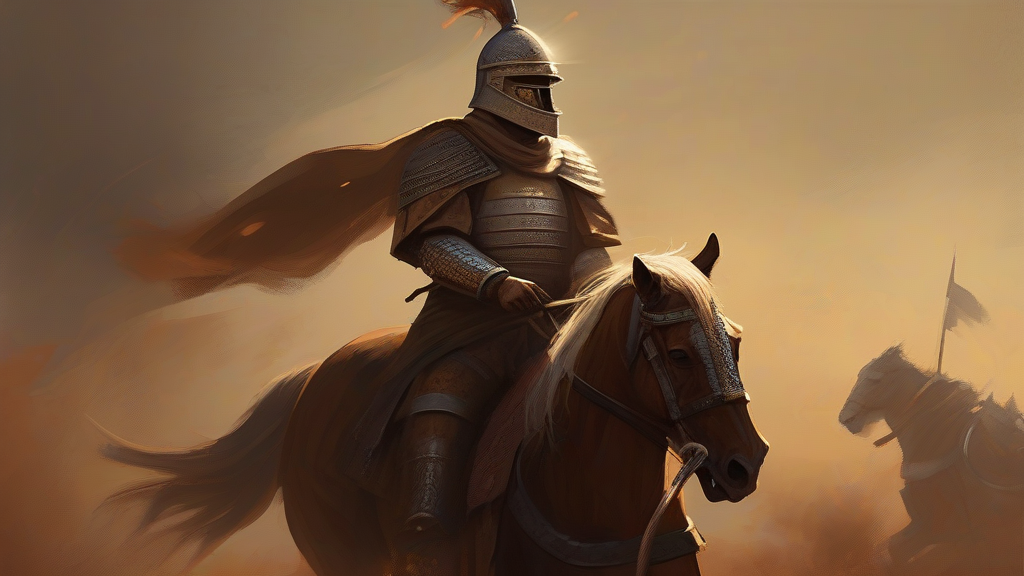
What does cataphract mean?
A cataphract is a heavily armored cavalryman of the ancient and late antique world, most famously associated with Persian, Parthian, Sassanid, and later Byzantine armies, whose horses were often armored as completely as their riders. The word can also refer to the armor itself. Cataphracts served as shock troops: riding in dense formations with lances, they delivered devastating charges that lighter troops could rarely withstand, though their great weight made them slow and vulnerable if dismounted or flanked. The term comes from the Greek kataphraktos, meaning 'covered over' or 'fully armored'. Today it appears almost exclusively in military history, wargaming, and historical fiction, giving it a scholarly, evocative register. It is useful for writers seeking precise vocabulary for pre-modern warfare and remains one of the most vivid terms for describing armored cavalry before the age of gunpowder.
A heavily armored cavalryman of classical and late antiquity whose horse was also armored.
"The Sassanid cataphracts formed the iron core of the Persian battle line."
Usually pluralized as 'cataphracts'; the singular is rare outside scholarly contexts.
The full body armor worn by such a cavalryman and his horse.
"The museum displayed a reconstructed cataphract of overlapping iron scales."
Standard plural; Latinized 'cataphractarii' occurs only in specialist references to Roman army units.
"Waves of Parthian cataphracts closed on the legion's exposed flank."
The cataphract was history's original tank — a man and horse sheathed head to toe in armor so heavy that both were often blind on the battlefield.
Reviewed by Deb Chak, Editor. AI-assisted content curated by RJS Tech Solutions LLP.
Etymology of cataphract
Cataphract derives from the Greek kataphraktos, meaning 'covered over' or 'armored', formed from kata- ('down, thoroughly') plus a verb meaning to enclose or fence off. The Romans adopted the Greek term directly as cataphractarius for certain armored cavalry units. It entered English in the early modern period through Latin, initially in scholarly descriptions of ancient warfare, and has remained a technical term of military history ever since. It shares its Greek root with words such as diaphragm.
Related word forms
How cataphract is actually used
An uncommon, learned word found mainly in military history and archaeology writing; it carries no figurative use in everyday English. The plural is usually 'cataphracts', though Latinized forms like 'cataphractarii' appear in specialist texts about Roman units.
Easily confused with cataphract
A catafalque is a raised platform bearing a coffin at funerals, while a cataphract is an armored cavalryman of antiquity.