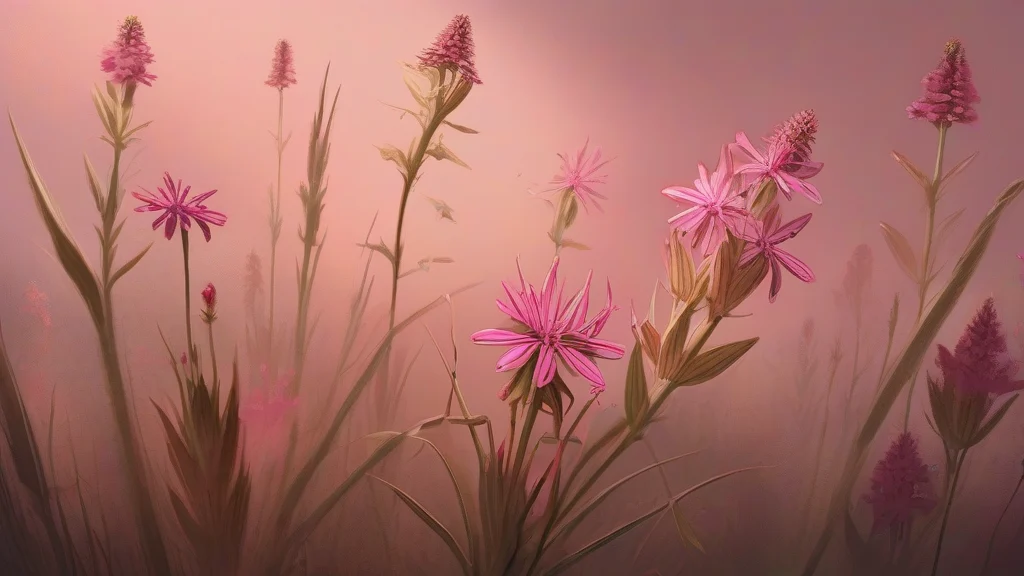
What does catchfly mean?
Catchfly is the common name for a group of flowering plants in the carnation family (Caryophyllaceae), especially members of the genera Silene and Lychnis. The name derives from the plant's most distinctive feature: its stems and leaves are covered in sticky, glandular hairs that frequently ensnare small insects such as flies. Despite what the name suggests, catchflies are not carnivorous; they do not absorb nutrients from their trapped visitors, which usually escape or die without benefiting the plant. Several species carry the name, including the sticky catchfly (Silene viscaria), prized in gardens for its vivid pink flower clusters, and the bladder catchfly (Silene vulgaris). In horticulture, catchflies are valued as hardy ornamentals suited to rockeries and cottage-garden borders, while in the wild they appear on grasslands, cliffs, and disturbed ground across Europe and North America. For gardeners and botanists alike, the word evokes an old-fashioned charm rooted in close observation of the plant world.
nounA flowering plant of the pink family, chiefly of the genera Silene and Lychnis, whose sticky stems or glands often trap small insects. The name refers to this adhesive quality rather than to any carnivorous habit.
- Any of various plants of the genera Silene and Lychnis having sticky, glandular stems that sometimes ensnare small insects.
"The roadside verge was brightened by clusters of red campion-like catchfly in early summer."
"The meadow was dotted with white catchfly, its stems glistening with resinous droplets after rain."
"Botanists note that catchfly does not actually feed on the insects that adhere to its sticky hairs."
The plural follows standard English noun formation, adding '-es'. It appears mainly in botanical writing and seed catalogues.
"Both white and red catchflies grew among the rocks above the shore."
Despite its name, catchfly isn't carnivorous — it just accidentally glues passing insects to its stem and lets them go.
Reviewed by Deb Chak, Editor. AI-assisted content curated by RJS Tech Solutions LLP.
Etymology of catchfly
The name catchfly arose in English as a compound of the familiar verbs-and-nouns 'catch' and 'fly', coined because the plant's sticky glands visibly trap flies. It belongs to a tradition of descriptive English plant common names dating back several centuries, when herbalists named plants after observable behaviours. Similar vernacular naming occurs in other languages, reflecting the same observation of the plants' adhesive qualities. The scientific genera involved, Silene and Lychnis, have classical roots: Lychnis comes from Greek lychnos, meaning 'lamp', a reference to the flame-coloured flowers of some species.
How catchfly is actually used
Catchfly is a botanical term used mainly in gardening, wildflower guides, and formal plant description rather than everyday speech. It functions as both a general common name for several species and as part of specific names such as 'sticky catchfly' (Silene viscaria) and 'bladder catchfly' (Silene vulgaris). The plural is typically 'catchflies'.
Easily confused with catchfly
Sundews genuinely capture and digest insects for nutrients, whereas catchfly merely traps them incidentally on its sticky surface without deriving nourishment.
Campion refers to closely related Silene species that lack notably sticky stems, while catchfly is named specifically for its glandular, insect-trapping coating.