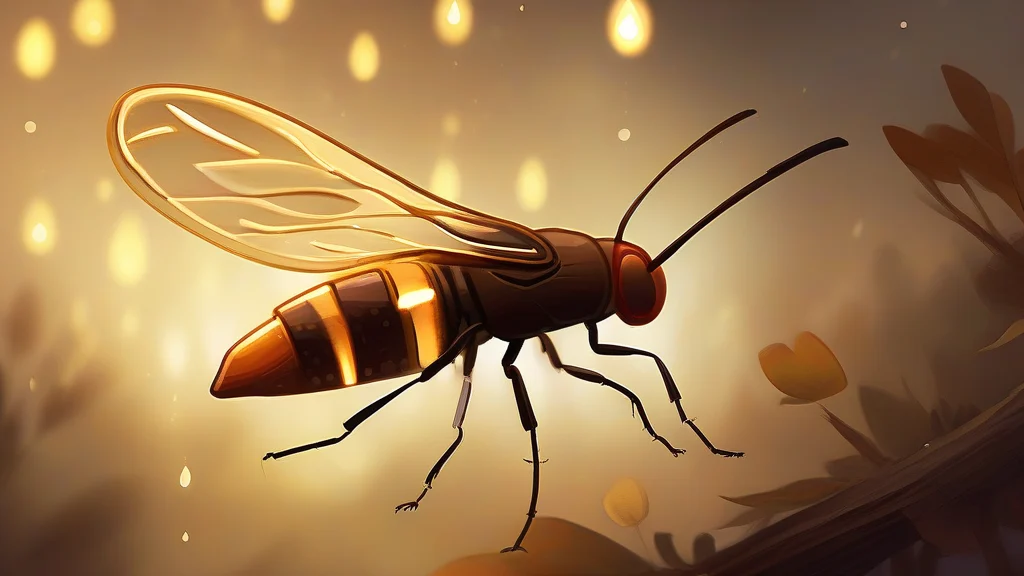
What does firefly mean?
A firefly is a nocturnal beetle belonging to the family Lampyridae, famous for producing flashes of light from the rear of its abdomen. This bioluminescence, created through a chemical reaction involving the enzyme luciferase, is used primarily to attract mates, with each species flashing in its own distinctive pattern. Despite the name, fireflies are neither flies nor true bugs — they are beetles — though in North America they are affectionately called 'lightning bugs.' The word carries strong connotations of warm summer evenings, childhood wonder, and rural landscapes, making it a favorite image in poetry and prose. Fireflies are most visible at dusk in meadows, forests, and gardens, and certain tropical species famously synchronize their flashes into spectacular collective displays. The term also extends informally to any small glowing insect encountered after dark.
nounA nocturnal beetle of the family Lampyridae that produces flashes of light from its abdomen, chiefly to attract mates. The name is also used more generally for any insect glowing in a similar way.
- Any nocturnal luminescent beetle of the family Lampyridae, whose adults flash light from the abdomen to attract mates or prey.
- More loosely, any small flying insect that glows, especially as referred to in literature or by children.
"As dusk fell over the meadow, fireflies rose from the grass in silent, blinking clouds."
"The children chased fireflies through the tall grass until well past bedtime."
"In some species of firefly, thousands of individuals flash in near-perfect unison along the riverbanks."
The standard plural simply adds -s to the compound; it behaves as an ordinary countable noun.
"Thousands of fireflies lit up the marshland after sunset."
Fireflies aren't flies at all — they're beetles that make light with nearly 100% efficiency, wasting almost no energy as heat.
Reviewed by Deb Chak, Editor. AI-assisted content curated by RJS Tech Solutions LLP.
Etymology of firefly
The word 'firefly' is an English compound formed from 'fire' and 'fly,' coined to describe insects that appear to carry light as they fly; it has been in use since at least the early seventeenth century. It parallels other English compounds built on '-fly' that describe flying creatures, such as 'dragonfly' and 'butterfly.' The underlying element 'fly' traces back to Old English 'flēoge,' the common name for the insect, while 'fire' descends from Old English 'fyr,' reflecting the insect's flame-like gleam.
How firefly is actually used
In North America 'lightning bug' is an equally common folk name for the same insect and the two are used interchangeably; in Britain the word 'firefly' is less familiar and 'glowworm' is the better-known term for native luminous beetles. Despite the 'fly' in its name, the firefly is a beetle, not a true fly.
Easily confused with firefly
Glowworms are the larval or wingless (chiefly female) stages of lampyrid beetles, which glow steadily rather than flashing in flight as winged adult fireflies do.