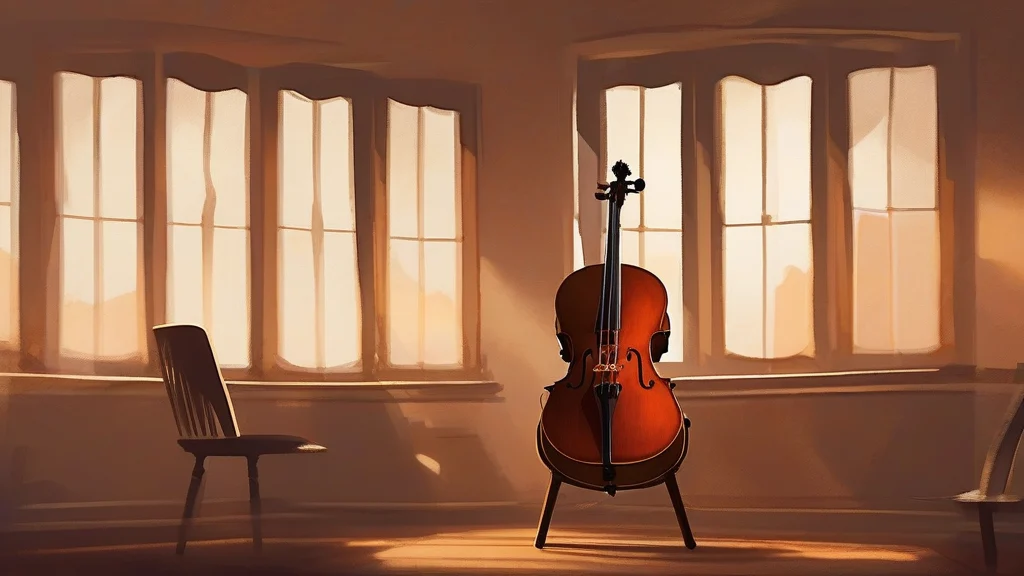
What does cello mean?
The cello is a large bowed string instrument belonging to the violin family, typically about four feet tall and played seated with the body of the instrument braced between the knees. It has four strings tuned to C, G, D, and A — an octave below the viola — and produces a warm, deep, human-voiced tone that has made it a favorite as both an ensemble instrument and a solo voice. The name is an abbreviation of the Italian "violoncello," adopted into English in the seventeenth century alongside the instrument itself. In an orchestra the cello section provides harmonic foundation and lyrical counter-melodies, while composers from Bach to modern film scorers have exploited its expressive range. A person who plays the cello is called a cellist. Its blend of power and intimacy gives it a uniquely prominent place in classical, folk, and contemporary music alike.
nounA large bowed string instrument of the violin family, held between the knees and played while seated, pitched an octave below the viola.
- The large four-stringed bowed instrument of the violin family, tuned C-G-D-A and held upright between the player's knees.
"She has played the cello with the youth orchestra for six years."
"The cellist's rich, resonant tone filled the concert hall during the Bach suites."
"He took up the cello at age nine and never put it down."
English uses the anglicized plural "cellos"; the Italian-style plural "celli" is considered nonstandard in modern English.
"The section of eight cellos gave the passage extraordinary warmth."
"Cello" isn't even the full name — it's a nickname clipped from the Italian "violoncello," literally meaning "little large viola."
Reviewed by Deb Chak, Editor. AI-assisted content curated by RJS Tech Solutions LLP.
Etymology of cello
Cello entered English in the late seventeenth century as a shortened form of the Italian "violoncello," the diminutive of "violone," meaning a large viol — so the name literally means "small large-viol," reflecting how the instrument was smaller than the bass violone but larger than the viola. The Italian root traces back through Old French "viole" to Latin "vitula," a term for a stringed instrument. Related words sharing this lineage include violin, viola, and viol.
Related word forms
How cello is actually used
The standard plural in English is "cellos" (not the Italian "celli"). The full Italian name "violoncello" survives mainly in formal or historical contexts, such as orchestral scores. The player is a cellist.
Easily confused with cello
Cellophane is a transparent wrapping material made from regenerated cellulose; despite the shared prefix, it has nothing to do with the musical instrument.