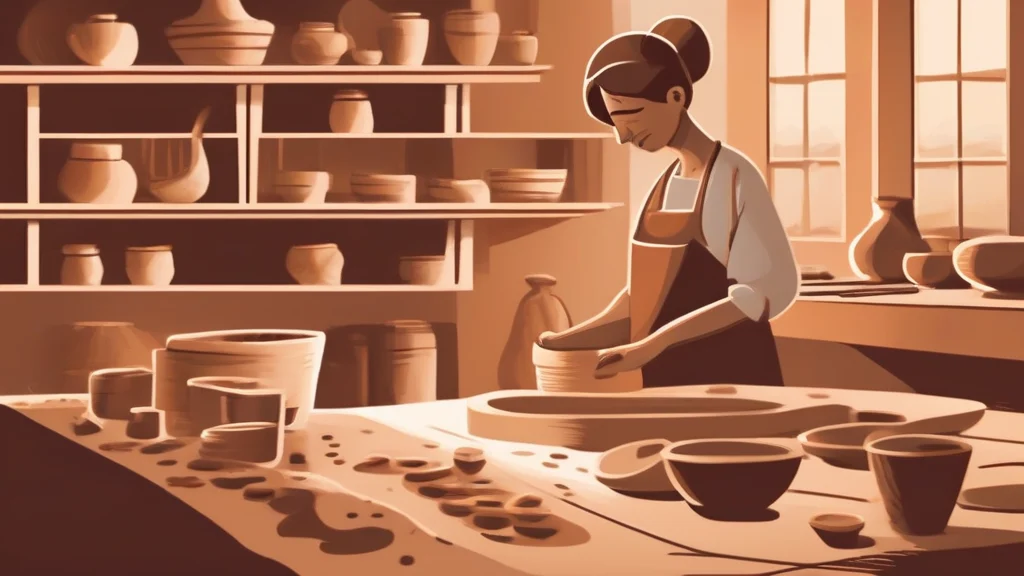
What does ceramicist mean?
A ceramicist is an artist or artisan who works with ceramics — most commonly shaping clay into functional or sculptural objects and hardening them through firing in a kiln. The word functions as a noun and covers the full breadth of the discipline, from wheel-thrown tableware and hand-built vessels to architectural tile and large-scale ceramic sculpture. It carries a professional, art-world connotation, often implying formal training or gallery-level practice, which distinguishes it slightly from the homelier 'potter'. The term derives ultimately from the Greek 'keramos', meaning potters' clay or pottery, via Latin and French routes that also produced the adjective 'ceramic'. Ceramicists appear frequently in discussions of studio craft, contemporary art, and design history, and the word pairs naturally with descriptors of style or nationality — as in 'a celebrated Danish ceramicist'. For anyone writing about the visual arts, it is the precise, respected term for a maker whose medium is earth transformed by fire.
nounAn artist or craftsman who creates objects from ceramic materials, especially by shaping and firing clay; a potter working in the broader field of ceramics.
- An artist or craftsperson who makes ceramic objects such as pots, tiles, sculpture, and tableware from fired clay.
"The ceramicist spent months perfecting the glaze for her new series of vessels."
"A celebrated Japanese ceramicist will lead next month's raku-firing workshop."
"After retiring from teaching, he reinvented himself as a full-time ceramicist, throwing bowls in his garden studio."
Standard regular plural; used when referring to multiple practitioners of ceramics.
"The exhibition brought together ceramicists from twelve countries."
The word traces back to 'keramos', the ancient Greek term for potters' clay — the same root that gave us 'ceramics' — so every time you say it, you're speaking the language of ancient Athenian potters.
Reviewed by Deb Chak, Editor. AI-assisted content curated by RJS Tech Solutions LLP.
Etymology of ceramicist
Ceramicist is built on 'ceramic', which entered English in the mid-nineteenth century from French 'céramique', itself borrowed from Greek 'keramikos', meaning 'of pottery' and derived from 'keramos' — potters' clay or earthenware. The agentive suffix '-ist' was added to denote a practitioner of the craft, producing a word essentially identical in meaning to the older, parallel form 'ceramist'. Both terms arose as studio pottery developed into a recognized profession in the nineteenth and twentieth centuries.
Related word forms
How ceramicist is actually used
Neutral to slightly formal register; common in art-world, museum, and gallery writing. 'Ceramicist' and 'ceramist' are interchangeable variants, with 'ceramicist' somewhat more frequent in British usage and both well established in American English. The term signals an artistic or professional practice, whereas 'potter' may suggest a narrower focus on wheel-thrown vessels.
Easily confused with ceramicist
Ceramist is a shorter variant meaning exactly the same thing; 'ceramicist' simply preserves more of the base word 'ceramic'.