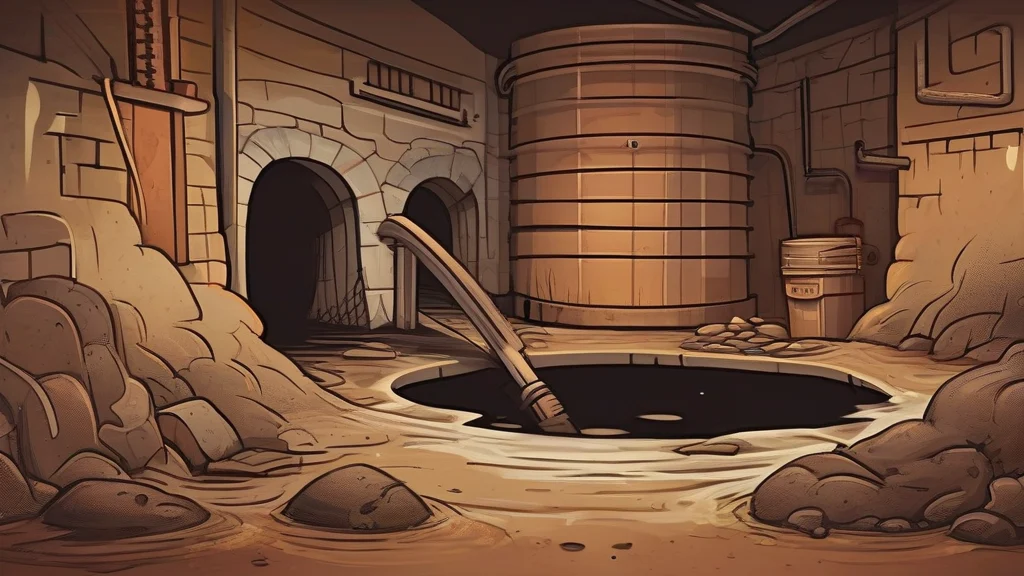
What does cesspit mean?
A cesspit is a pit or covered chamber — usually dug into the ground beneath or near a building — that collects sewage and household wastewater where no mains drainage exists. Unlike a septic tank, which treats waste biologically, a traditional cesspit simply holds it until it can be pumped out or emptied by tanker. The word is most common in British English, where 'cesspool' serves as its close synonym; American usage favours the latter term. Beyond its literal sanitary meaning, 'cesspit' has acquired a powerful figurative sense: journalists and critics routinely describe corrupt institutions, lawless districts, or online spaces as 'a cesspit of lies' or 'of corruption', invoking images of filth and decay. This metaphorical use gives the word a vividly pejorative force, making it a staple of polemical writing. Its roots lie in the Italian verb 'cessare', meaning to drain or discharge, tying it linguistically to a family of Latinate borrowings.
nounA pit or covered tank, typically underground, for collecting sewage or household waste; more broadly, a place regarded as filthy, squalid, or morally corrupt.
- A pit or tank for collecting and storing sewage or household waste, especially one that must be emptied rather than draining away.
- Figuratively, a place or situation characterized by filth, squalor, or moral degradation.
"The old farmhouse still relied on a brick cesspit until mains drainage finally reached the village."
"The cottage had no mains drainage and depended on a concrete cesspit at the end of the garden."
"He described the city's underworld as a cesspit of bribery and vice."
Regular plural; used both literally (multiple waste pits) and figuratively.
"Inspectors found overflowing cesspits behind several of the cottages."
The word 'cess' in cesspit comes from an Italian word meaning 'to drain', which itself gave English words like 'access' and 'concession' — so the same ancient root links your plumbing to your legal contracts.
Reviewed by Deb Chak, Editor. AI-assisted content curated by RJS Tech Solutions LLP.
Etymology of cesspit
The first element of 'cesspit' derives from the Italian 'cesso', meaning a privy or drain, from Latin 'cessus' (a draining), related to 'cedere', to go or yield — the same root behind English words such as 'cessation' and 'access'. 'Cesspool' arose as a variant form, likely influenced by association with 'pool'. The compound entered English around the early modern period, when 'cesspit' became the standard British label for a domestic waste-holding pit, later extending figuratively to any place of moral filth.
Related word forms
How cesspit is actually used
'Cesspit' is the standard term in British English for a simple waste-holding pit, with 'cesspool' as a near synonym that is preferred in American English. The word is neutral when describing sanitation but carries strongly negative, often hyperbolic connotations in figurative use, typically in journalism or polemic to condemn institutions or places as corrupt.
Easily confused with cesspit
A cesspool is essentially synonymous with a cesspit as a sewage pit, but in figurative use 'cesspool' is far more common in American English while 'cesspit' is the usual British choice.
A septic tank is an engineered chamber that treats sewage through bacterial decomposition, whereas a cesspit is merely a holding pit that must be regularly emptied.