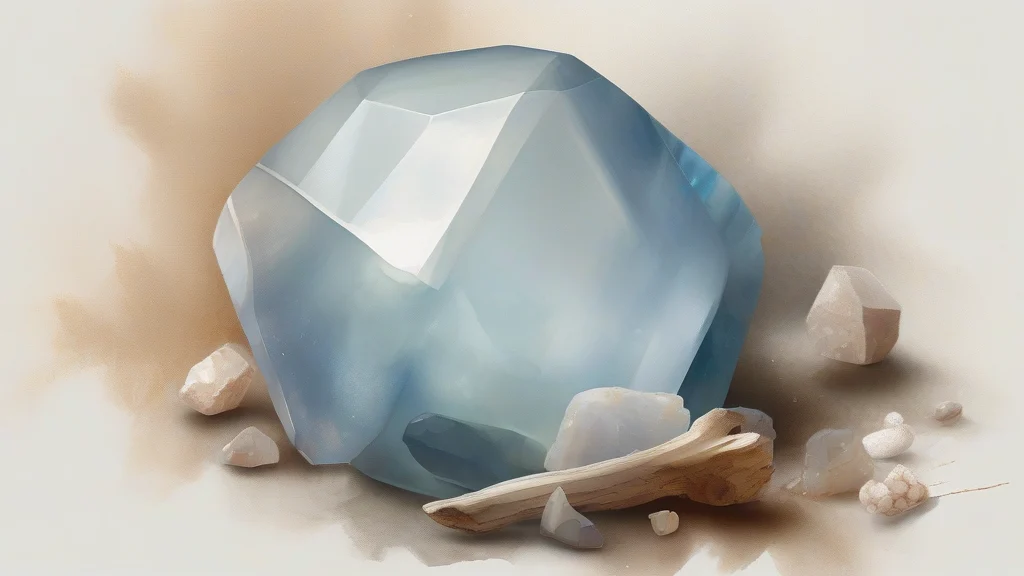
What does chalcedony mean?
Chalcedony is a semiprecious gemstone composed of microcrystalline quartz, meaning its crystals are so fine that they are visible only under magnification, giving the stone a smooth, waxy, often translucent appearance. It occurs in a wide range of colors — white, gray, blue, brown, and banded forms among them — and many familiar gems are actually varieties of chalcedony, including agate, onyx, carnelian, and jasper. Because of its durability and even texture, chalcedony has been prized for millennia: ancient craftsmen carved seals, cameos, and intaglios from it, and jewelers still use it today, particularly in beads, pendants, and cabochons. The word derives ultimately from Chalcedon, an ancient Greek city on the Bosporus, reflecting the stone's long association with classical trade. In modern usage, chalcedony carries connotations of understated elegance rather than showy luxury, and it appears chiefly in mineralogical, archaeological, and jewelry contexts rather than casual conversation.
nounA semi-precious gemstone consisting of a microcrystalline form of quartz, typically occurring in white, gray, blue, or brownish masses and used in jewelry and ornamentation.
- A semi-transparent to opaque microcrystalline variety of quartz occurring in many colors and used as a semiprecious gemstone.
"The artisan carved the signet ring from a smooth piece of blue chalcedony."
"She wore a delicate pendant set with pale blue chalcedony."
"Ancient engravers favored chalcedony for seals because its fine, even texture took detail beautifully."
Usually uncountable when referring to the material itself; the plural is used mainly by collectors or dealers to refer to individual specimens or varieties.
"The dealer's case held dozens of polished chalcedonies in every shade of blue and gray."
The city of Chalcedon gave its name to the stone — and while the Council of Chalcedon shaped Christian history, chalcedony has been quietly gracing rings and seals since antiquity.
Reviewed by Deb Chak, Editor. AI-assisted content curated by RJS Tech Solutions LLP.
Etymology of chalcedony
The word chalcedony comes from Latin chalcedonius, borrowed from Greek khalkēdōn, referring to Chalcedon, an ancient Greek city located on the Asian shore of the Bosporus opposite Byzantium. The stone was evidently associated with or traded through that region in antiquity, which is why a place name became the mineral's name. English adopted the term via Old French in the medieval period, with established use by the late Middle Ages. A derived adjective, chalcedonic, describes things resembling or relating to the stone.
Related word forms
How chalcedony is actually used
Chalcedony appears almost exclusively in mineralogy, gemology, and discussions of jewelry or antiquities, giving it a formal, specialist register. In everyday speech, specific named varieties such as agate, onyx, carnelian, and jasper are more familiar, though all are technically forms of chalcedony.
Easily confused with chalcedony
Calcite is a crystalline calcium carbonate mineral, whereas chalcedony is a fibrous microcrystalline form of silica (quartz); the similar spellings and geological contexts make them easy to mix up.