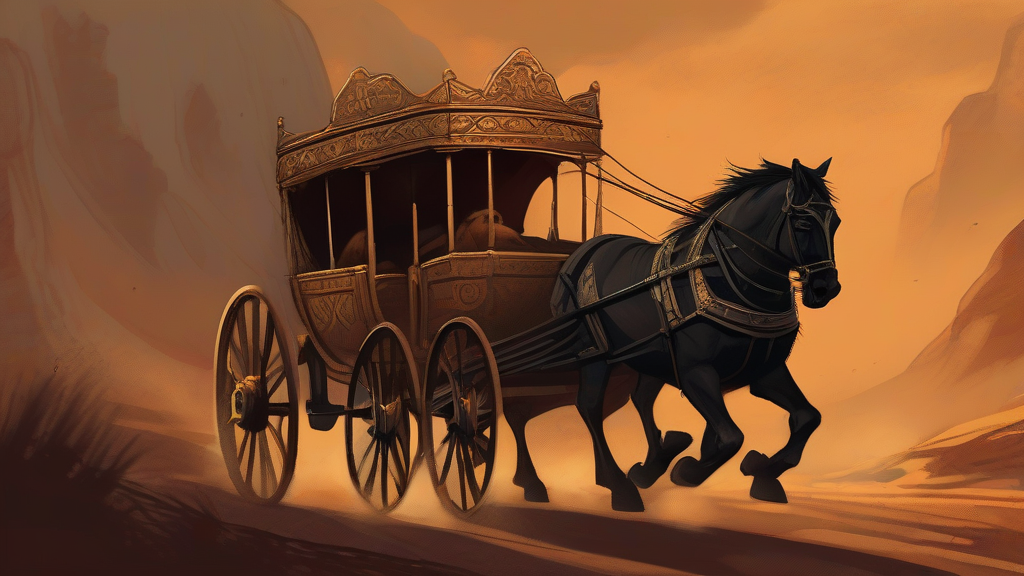
What does chariot mean?
A chariot is a light, open, two-wheeled horse-drawn vehicle used chiefly in the ancient world for warfare, hunting, racing, and ceremony. Typically drawn by two or four horses and carrying a standing driver, sometimes alongside a warrior armed with bow or spear, the chariot was prized for its speed and mobility on flat ground. It features prominently in the histories of Egypt, Mesopotamia, Greece, Rome, India, and China, appearing everywhere from the Olympic-style races of the Roman circus to Hindu epic poetry. Today the word survives mainly in historical, literary, and religious contexts, often evoking drama and splendour — as in Elijah's fiery chariot or Hollywood recreations of Roman races. Its related noun 'charioteer' refers to the driver, a role so significant that it appears as both an occupation and a constellation name.
nounA two-wheeled horse-drawn vehicle used in ancient warfare and racing, typically carrying a driver and one or more passengers standing upright.
- An ancient light, open, two-wheeled horse-drawn vehicle used for warfare, racing, or ceremonial purposes.
"The Roman crowd roared as the chariot racers thundered around the Circus Maximus."
"Egyptian pharaohs rode into battle on elaborately decorated chariots."
"Ben-Hur's chariot sequence remains one of cinema's most celebrated action scenes."
Standard regular plural; countable in all senses.
"Dozens of chariots lined the starting gates before the race began."
Chariots were the tanks of the ancient world — fast, terrifying to infantry, and obsolete within centuries once cavalry learned to ride.
Reviewed by Deb Chak, Editor. AI-assisted content curated by RJS Tech Solutions LLP.
Etymology of chariot
'Chariot' entered English in the early 14th century from Old French 'charriot', a diminutive of 'char', meaning cart or wagon. The French term ultimately derives from Latin 'carrus', a Gallic-origin word for a wheeled vehicle, which also gave English 'car', 'carry', 'carriage', and 'cargo'. This shared root makes these everyday words distant cousins of the ancient war vehicle.
Related word forms
How chariot is actually used
Almost always used in historical, archaeological, mythological, or figurative contexts, since chariots are no longer in practical use. The word carries connotations of antiquity, grandeur, and spectacle. The agent noun 'charioteer' denotes the driver of a chariot.
Easily confused with chariot
A cart is a heavier, slower vehicle for carrying goods, while a chariot is a light, fast two-wheeled vehicle designed for speed, racing, or battle.
A carriage is an enclosed passenger vehicle for comfort and transport, whereas a chariot is open, minimal, and built for combat or spectacle.