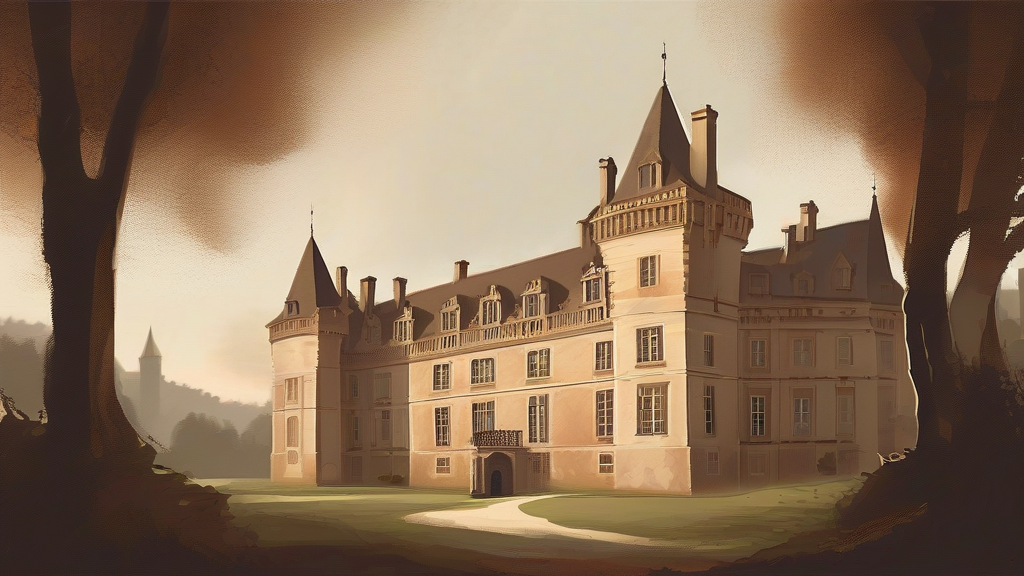
What does chateaux mean?
Chateaux is the plural of chateau, denoting the grand country houses and castles of France, particularly those built by nobility amid sweeping parks and formal gardens. The word also extends to wine estates, especially in Bordeaux, where a chateau's name on a bottle signifies both the property and the wine produced there. In English, writers may use either the French plural 'chateaux' or the anglicized 'chateaus', though the former remains more common and lends a suitably elegant tone. The term evokes luxury, romance, and centuries of history — think of the celebrated chateaux of the Loire Valley, such as Chambord and Chenonceau, which draw millions of visitors. Figuratively, it can describe any opulent residence that resembles these stately French landmarks.
nounThe plural of chateau (château): a large French country house or castle, especially one associated with nobility and set in extensive grounds, or a wine-producing estate in France.
- Plural of chateau: large French country houses or castles, typically of noble origin and set in landscaped grounds.
- Plural of chateau: wine-producing estates in France, especially in Bordeaux, whose name appears on the label.
"The Loire Valley is famous for its grand Renaissance chateaux."
"Tourists flock each summer to the fairy-tale chateaux along the Loire River."
"The region's finest chateaux command staggering prices at auction."
'Chateaux' follows the French plural convention and is the traditional, more common form; 'chateaus' is a fully accepted anglicized alternative.
"The countryside is dotted with historic chateaux."
English kept the French spelling for the plural of chateau but happily added a plain -s for the alternative — so both 'chateaux' and 'chateaus' are correct, a rare double plural borrowed straight into the dictionary.
Reviewed by Deb Chak, Editor. AI-assisted content curated by RJS Tech Solutions LLP.
Etymology of chateaux
Chateaux comes from the French château, which developed from Old French chastel, itself derived from the Latin castellum, a diminutive of castrum meaning fort or fortified place. The same Latin root gives English its native word 'castle' as well as related forms like 'castellan' and 'châtelaine'. English adopted château in the early modern period, retaining both the French spelling and the distinctive French-style plural in -eaux alongside an anglicized alternative in -eaus.
Related word forms
How chateaux is actually used
Both the anglicized plural 'chateaus' and the French-style 'chateaux' are accepted in English; 'chateaux' is the more traditional and frequent form, especially in writing about France. The word carries connotations of wealth, history, and aristocratic elegance, and is often used figuratively to describe any palatial residence.
Easily confused with chateaux
Chateau is the singular form referring to one building or estate, while chateaux is the standard French-style plural referring to more than one.
A chalet is a wooden alpine house with a sloping roof, whereas a chateau is a grand French castle or country house.