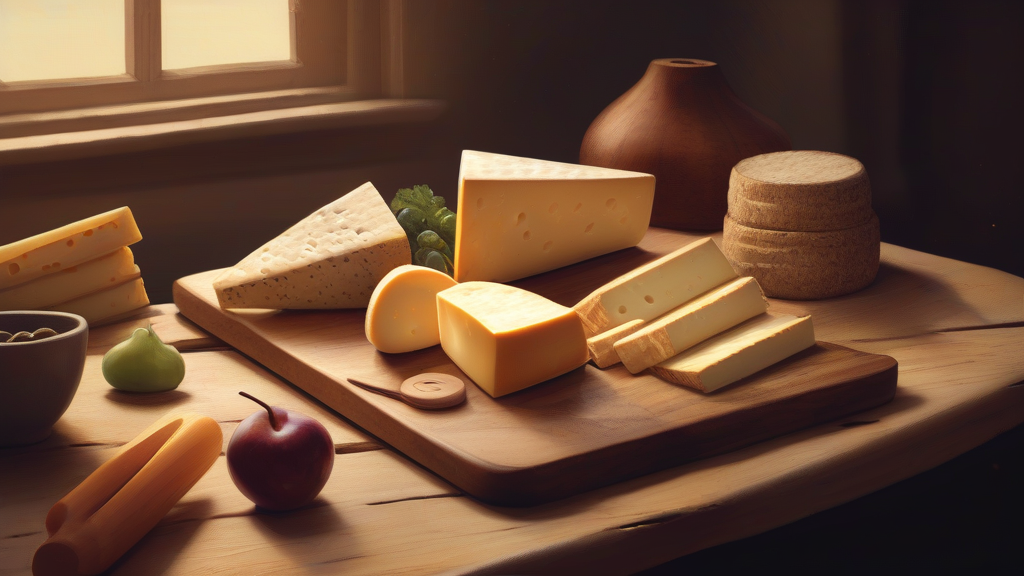
What does cheeseboard mean?
A cheeseboard is a board—traditionally wood, though slate and marble are common—on which cheese is presented and served, typically alongside crackers, bread, fruit, nuts, chutneys, or honey. The term also refers by extension to the selection of cheeses and accompaniments themselves, as when a menu offers a 'cheeseboard' as a course. Once a modest fixture of British meals and wine tastings, the cheeseboard has enjoyed a strong revival in recent decades as home entertaining and casual dining have embraced grazing-style presentations. It carries connotations of conviviality and generosity: a well-assembled cheeseboard invites guests to help themselves and linger over conversation. The word is straightforwardly transparent—a compound of 'cheese' and 'board'—and appears in both everyday speech and food writing across Britain, North America, Australia, and elsewhere. Related terms such as 'cheese platter' and 'cheese plate' are largely interchangeable, though 'cheeseboard' retains a slightly more traditional, rustic flavour.
nounA board on which cheese is served, often accompanied by crackers, fruit, nuts, and other accompaniments; by extension, the selection of cheeses itself.
- A wooden or slate board on which cheese and its accompaniments are presented and served.
- The assortment of cheeses (and accompanying items) served at a meal or gathering.
"She assembled a lavish cheeseboard of aged cheddar, figs, walnuts, and honey for the dinner party."
"The waiter brought out a large oak cheeseboard with three farmhouse cheeses and a jar of chutney."
"For New Year's Eve they skipped dessert and put together an enormous cheeseboard instead."
Standard regular plural; commonly used in retail and catering contexts referring to multiple boards.
"The shop sells handcrafted olive-wood cheeseboards made by local artisans."
The humble cheeseboard has become so fashionable that 'building a cheeseboard' is now an art form with its own hashtags, tutorials, and even professional stylists.
Reviewed by Deb Chak, Editor. AI-assisted content curated by RJS Tech Solutions LLP.
Etymology of cheeseboard
Cheeseboard is a straightforward English compound formed from 'cheese', which descends from Old English 'cīese' (ultimately from Latin 'caseus'), and 'board', from Old English 'bord', meaning a plank or table. The compound follows a long English pattern of forming words for serving surfaces, as seen in 'cupboard' and 'sideboard'. Such compounds arose naturally as dining customs developed; no single inventor or precise first-attested date is firmly established, but the word has been in common use since at least the nineteenth century.
How cheeseboard is actually used
The word is informal to neutral in register. In modern hospitality usage it frequently implies a curated presentation rather than a simple serving board, and the second sense (the selection of food itself) is increasingly common on menus and in food writing.
Easily confused with cheeseboard
A charcuterie board centres on cured meats, whereas a cheeseboard centres on cheeses — though the terms are often combined in practice.