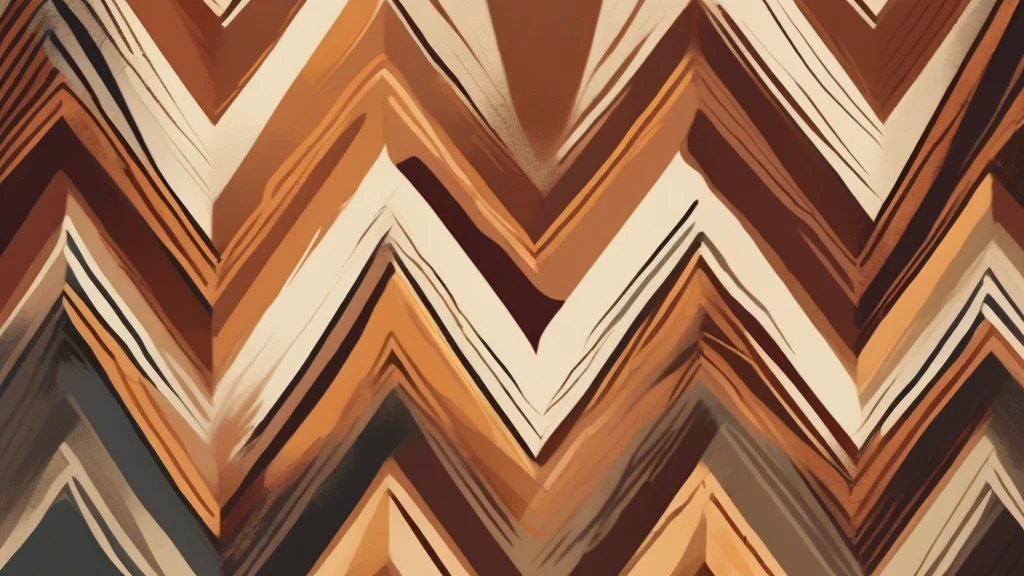
What does chevron mean?
A chevron is a distinctive V-shaped figure used across many fields of human endeavour. Most familiar today from military and police uniform insignia — where stripes on a sleeve denote rank or length of service — the chevron also appears widely in graphic design, road markings, and interior décor, where repeating chevrons create striking zigzag patterns. In heraldry it is one of the classic 'ordinaries', a broad band shaped like an inverted V across a shield, while in medieval architecture the term describes the carved zigzag mouldings characteristic of Norman Romanesque stonework. The word derives from the Old French for a roof rafter, reflecting the shape's resemblance to the angled beams of a pitched roof. Whether signalling authority on a uniform or adding rhythm to a tiled floor, the chevron endures as a simple geometric form with remarkable versatility and visual force.
nounA chevron is a V-shaped pattern or symbol, especially one used in heraldry, military insignia to denote rank, architecture, and road markings. It can also refer to the badge itself worn on a sleeve indicating rank or length of service.
- A V-shaped line or pattern, especially as an ornamental or decorative design.
- A V-shaped badge worn on military or police uniforms to indicate rank or length of service.
- In heraldry: an ordinary consisting of a broad V-shaped band across a shield.
- In architecture: a moulding or ornament forming zigzag patterns, common in Norman Romanesque work.
"The sergeant's sleeve bore three chevrons, each marking years of loyal service."
"The floor tiles were laid in bold black-and-white chevrons that drew the eye down the hallway."
"After five years of service she was awarded her first chevron."
Standard regular plural. In military contexts 'the chevrons' commonly refers to rank insignia as a whole.
"The wall was decorated with alternating red and gold chevrons."
That V-shaped stripe on a soldier's arm has been shouting rank for centuries — and it all started with a French word for rafter.
Reviewed by Deb Chak, Editor. AI-assisted content curated by RJS Tech Solutions LLP.
Etymology of chevron
Chevron entered English from Anglo-Norman and Middle French around the fourteenth to fifteenth centuries, deriving ultimately from the Vulgar Latin *caprionem, a derivative of caper meaning 'goat', via the notion of something resembling a pair of rafters meeting at an angle like a goat's legs. The original sense referred to a roof rafter, and the V-shape association led naturally to its use in heraldry and later in military insignia. Cognates include the related French architectural and heraldic terms built on the same root.
How chevron is actually used
Chevron is most commonly encountered in design and military contexts. In British English the plural is typically 'chevrons' when referring to rank insignia collectively. The word carries neutral-to-formal register depending on context — casual in interior design talk, technical in heraldry.
Easily confused with chevron
"Sherron" is not a standard English word; it may be a misspelling of "sheraton" (a style of furniture) — chevron, by contrast, refers specifically to a V-shaped mark or pattern.
"Cherubim" refers to angelic beings, whereas "chevron" denotes a V-shaped figure; they share only superficial phonetic similarity.