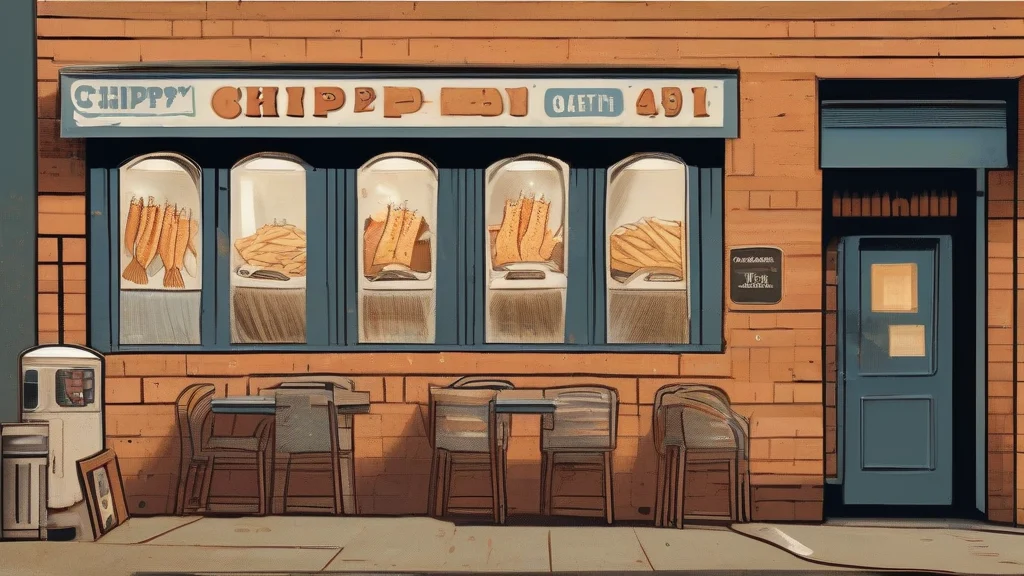
What does chippy mean?
Chippy is an informal word whose meaning depends heavily on where you are. In Britain, a chippy is a fish-and-chip shop — a beloved institution where battered fish and fried potatoes are wrapped in paper and eaten, often on the way home. In Australia and New Zealand, the same word informally denotes a carpenter, a nod to wood chips. In North America, chippy functions as an adjective describing someone who is irritable, touchy, or quick to take offence, as in 'he's been chippy since the reorganisation.' The word derives from 'chip,' either the fried potato chip that gives the shop its name or the wood chips of the carpenter's trade. All its senses are casual and conversational rather than formal. Because its meaning shifts so sharply across regions, context is essential: a Briton praising a chippy is recommending dinner, while an American describing a colleague as chippy is complaining about their mood.
A fish-and-chip shop (British English).
"There's a good chippy just around the corner from the station."
A carpenter (Australian and New Zealand English).
"The builders brought in a chippy to hang the new doors."
Irritable, touchy, or inclined to take offence (informal, chiefly North American).
"She seemed a bit chippy when asked about her earlier comments."
Used only for the noun senses; there were chippies on every high street once.
"Most seaside towns still have at least one of the old chippies left."
In Britain, 'going down the chippy' is a national ritual — but say 'chippy' to a carpenter in Australia and you're talking about their trade, not their dinner.
Reviewed by Deb Chak, Editor. AI-assisted content curated by RJS Tech Solutions LLP.
Etymology of chippy
Chippy is formed simply from 'chip' plus the suffix '-y', following the common English pattern of creating informal nouns for places associated with something (as in 'deli' from delicatessen). The British sense for a fish-and-chip shop arises directly from the chips sold there, while the Australian carpenter's term comes from wood chips. The adjectival sense meaning irritable appears to have developed separately, likely from the notion of someone who has 'a chip on his shoulder' — a phrase itself rooted in the old custom of carrying a wood chip as a challenge to fight. Its earliest uses date to the nineteenth century.
Related word forms
How chippy is actually used
All senses are informal. The 'fish-and-chip shop' sense is distinctly British; calling someone chippy in the adjectival sense is chiefly North American and implies oversensitivity or resentment. The carpentry sense is confined to Australia and New Zealand. The dated sense referring to a promiscuous woman is offensive by modern standards.
Easily confused with chippy
Cheeky means impudently playful or disrespectful in a charming way, whereas the adjectival 'chippy' means irritable or easily offended.