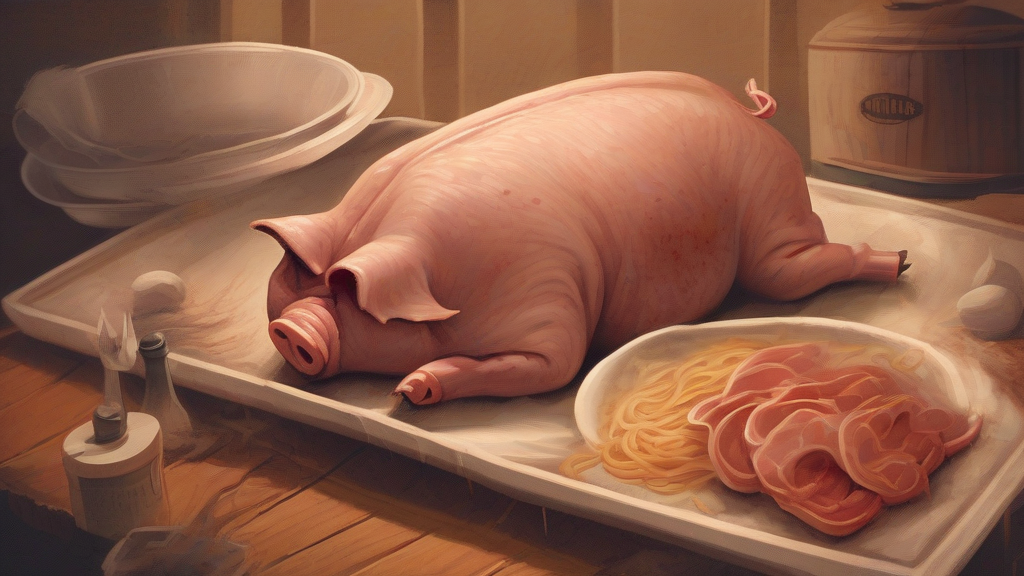
What does chitlin mean?
A chitlin is the small intestine of a pig, cleaned, boiled, and often deep-fried, and eaten most famously in the culinary traditions of the American South. The word is an informal American shortening of the older English term 'chitterling', and in everyday speech it almost always appears in the plural form 'chitlins', whether one is talking about a single piece or the dish as a whole. Chitlins hold a significant cultural place in African-American cooking, where they emerged from the historical practice of making use of every part of the animal allotted to enslaved people; today they remain a fixture of soul-food menus and holiday tables, typically seasoned with vinegar, garlic, and hot peppers. Beyond the kitchen, the phrase 'chitlin circuit' refers to the network of venues across segregated America where Black musicians and comedians performed, giving the humble word a notable place in entertainment history. Informal in register, the term carries strong regional identity and evokes heritage and resourcefulness more than delicacy.
nounA chitlin is the small intestine of a pig, cleaned and typically boiled or deep-fried, eaten especially in Southern United States cuisine. It is the usual American shortened form of 'chitterling'.
- A pig's small intestine, cleaned and cooked as food, especially in the American South.
- (usually plural, 'chitlins') The dish made from these intestines, traditionally associated with African-American and Southern soul-food cooking.
"Every New Year's Day, her family simmered chitlins with vinegar and hot sauce until the whole house smelled of them."
"The diner served fried chitlins with collard greens and cornbread every Friday."
"Back in the sixties, any band hoping to break into soul music had to survive a season on the chitlin circuit."
The plural is by far the most common form in both speech and writing, often used as a mass noun for the dish.
"Fried chitlins were the centerpiece of the holiday spread."
The 'chitlin circuit' gave Black performers like Aretha Franklin and Jimi Hendrix their first stages — all named after a humble dish of fried pig intestines.
Reviewed by Deb Chak, Editor. AI-assisted content curated by RJS Tech Solutions LLP.
Etymology of chitlin
The word derives from Middle English 'chitterling', which denoted the intestines of animals used as food and appears in English texts from around the fourteenth century. It likely stems from Old English 'cwið', meaning womb or belly, combined with a diminutive suffix, though the precise development of the form is debated. The shortened American form 'chitlin' arose in the speech of the Southern United States, where the dish became central to African-American cuisine. Related forms appear across Germanic languages reflecting the same ancient root.
How chitlin is actually used
Almost always used in the plural ('chitlins') even when referring to the dish generally; the singular 'chitlin' appears chiefly in fixed phrases like 'chitlin circuit'. Register is informal and regional, tied strongly to Southern and African-American foodways. Spelling varies widely: chitlin, chittlin, chitling, chittling. Because the dish requires labor-intensive cleaning, it carries connotations of traditional home cooking rather than restaurant fare.
Easily confused with chitlin
Chitin is the tough polysaccharide forming insect shells and fungal cell walls, whereas a chitlin is pig intestine prepared as food.
Chitterling is the older, fuller English form of the same word; chitlin (also spelled chittlin) is its American colloquial shortening.