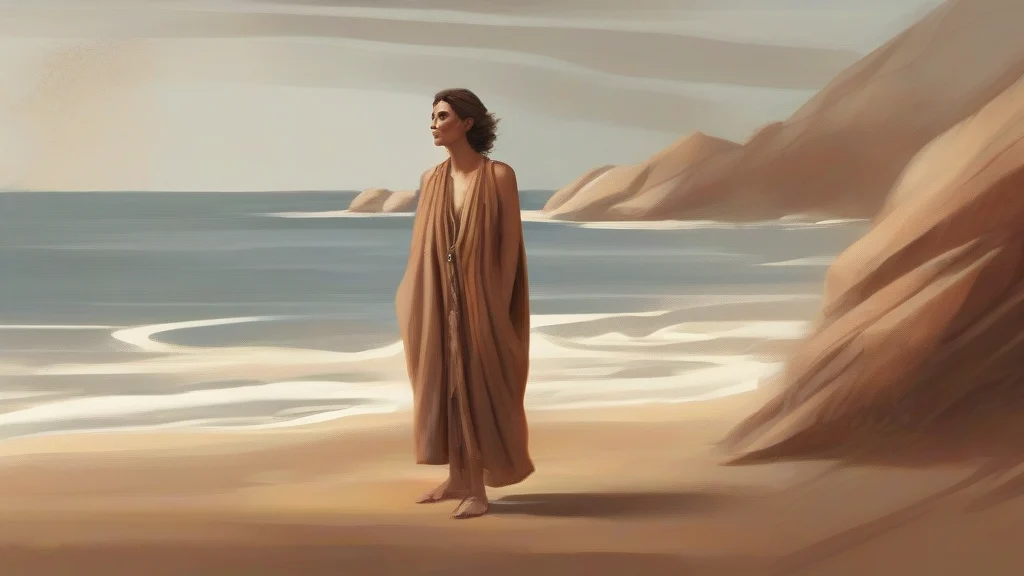
What does chiton mean?
A chiton is, most familiarly, a garment of the ancient Greek world: a loose tunic, usually of wool or linen, worn by both men and women and fastened at the shoulders with pins or brooches. Its two main variants, the simpler Doric and the more elaborate Ionic, are staples of classical art and costume history, so the word turns up constantly in descriptions of sculpture, vase painting, and theatrical dress. Less famously, chiton is also the name of a marine mollusk found on rocky shores worldwide, recognizable by its oval body armor of eight overlapping plates. The word comes from the Greek khitōn, itself likely borrowed from a Semitic source, giving it a lineage as old as the clothing it describes. Whether encountered in a museum gallery or a tide pool guide, it carries a distinctly learned, precise flavor.
An ankle-length tunic worn in ancient Greece, typically sleeveless and fastened at the shoulder with a fibula or brooch.
"The marble figure's chiton falls in delicate vertical folds."
Classical scholars distinguish the Doric chiton (wool, simply pinned) from the Ionic chiton (finer linen, fuller and often belted).
Any marine mollusk of the class Polyplacophora, having a flattened elliptical body protected by eight articulated dorsal shell plates.
"A chiton pried loose from the stone curled into a protective ball."
Regular English plural; used for both garments and mollusks.
"The frieze shows a procession of women in flowing chitons."
The same word names what Greeks wore and what clings to seaside rocks — one of English's rare double lives.
Reviewed by Deb Chak, Editor. AI-assisted content curated by RJS Tech Solutions LLP.
Etymology of chiton
English borrowed chiton directly from Greek khitōn, meaning 'tunic', a word the Greeks themselves may have acquired from a Semitic language cognate with Hebrew kethōneth ('garment'). The garment sense entered English usage during the Renaissance revival of interest in classical antiquity and became widespread in the nineteenth century alongside the study of Greek art. Naturalists later applied the same word to the plated marine mollusks, whose form vaguely recalled a small armored tunic.
How chiton is actually used
Both pronunciations are heard: KAI-ton and KIT-on. The garment sense dominates in art history and classics; the mollusk sense appears mainly in marine biology and coastal naturalism.
Easily confused with chiton
Chitin is the tough polysaccharide making up insect and crustacean shells, while a chiton is either an ancient Greek garment or a shelled marine mollusk.