What does chopine mean?
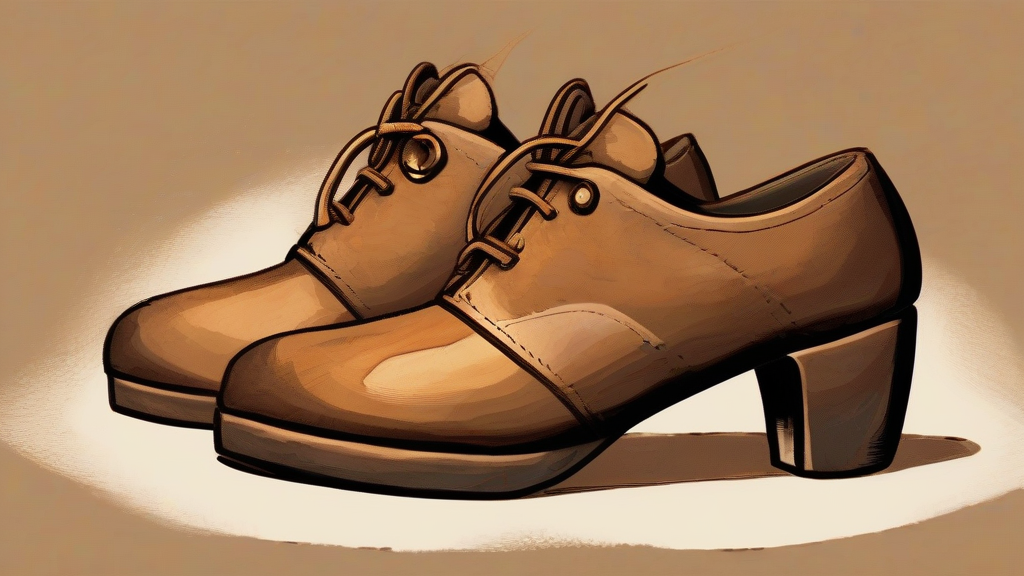
A chopine is a type of platform shoe worn by women in Europe, above all in Venice, during the late fifteenth and sixteenth centuries. Built on thick soles of layered cork or wood—sometimes rising more than fifty centimetres—chopines served as much as status symbols as footwear: the higher the sole, the greater the wearer's social standing. Covered in fine silks and velvets, they transformed a woman's silhouette, lengthened the line of her gown, and protected delicate shoes from muddy streets, but walking on them often required attendants for support. The word survives today mainly in costume history, museum catalogues, and literary commentary—notably Shakespeare's references in Hamlet—and remains a striking example of how fashion has historically traded comfort for spectacle and display.
nounA chopine is a woman's platform shoe with an elevated sole, popular in Europe—especially Venice—from roughly the late 15th to the early 17th century.
- A woman's platform shoe with an extremely high sole of cork or wood, fashionable in Europe from about the late 15th through the 16th centuries.
"The portrait showed a Venetian noblewoman in a brocade gown, her hem lifted to reveal towering chopines."
"Museum curators displayed a pair of silk-covered chopines beside the Renaissance costumes."
"In Shakespeare's Hamlet, the prince jokes that lady's gait was raised by her chopines."
The standard plural; because shoes are usually discussed in pairs, the plural form appears far more often than the singular.
"The exhibition featured chopines from several sixteenth-century Italian collections."
Sixteenth-century Venetian women tottered on chopines so tall—sometimes over half a metre—that they needed servants or canes simply to walk.
Reviewed by Deb Chak, Editor. AI-assisted content curated by RJS Tech Solutions LLP.
Etymology of chopine
Chopine derives ultimately from Spanish 'chapín', a type of wooden overshoe or platform clog, and entered English via French 'chopine' in the sixteenth century. The deeper etymology of the Spanish word is uncertain, though it is sometimes linked to 'chapa', meaning metal plate or veneer, itself from Latin. Its cognate 'chapín' survives in Spanish, preserving the same sense of an elevated wooden sole.
How chopine is actually used
Chopine is a rare, chiefly historical term used in discussions of Renaissance costume, fashion history, and literature; it appears almost exclusively in formal or scholarly registers rather than everyday speech.
Easily confused with chopine
'Chopin' is most familiar as the surname of the Polish composer Frédéric Chopin and is also a historical unit of liquid measure, whereas a chopine is an elevated platform shoe; despite the similar spelling they are unrelated words.