What does chorale mean?
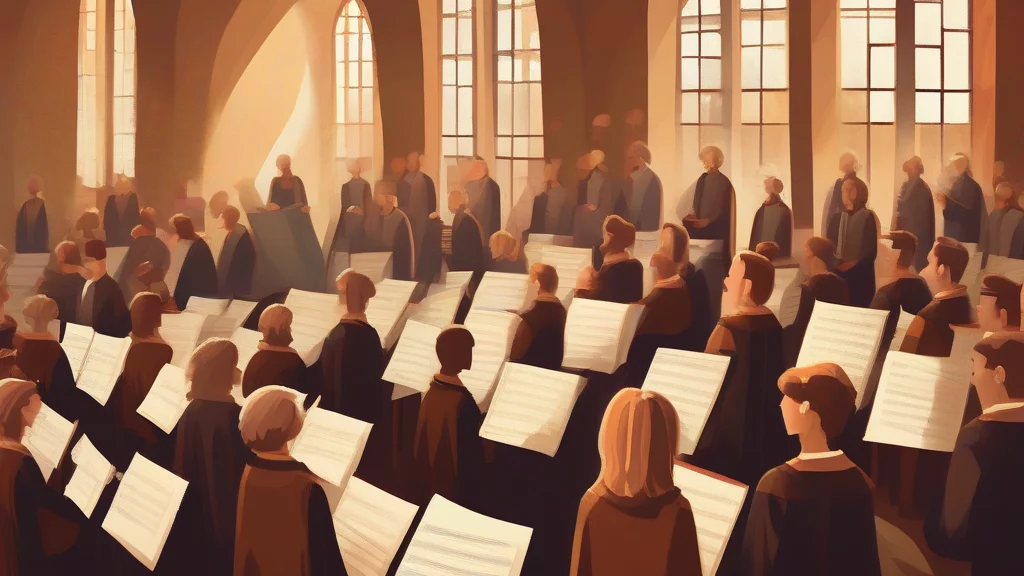
A chorale is a hymn tune associated above all with the German Lutheran church, written so that a whole congregation can sing it together in unison. Emerging from the Reformation, when Martin Luther promoted vernacular singing as a central act of worship, the chorale became the backbone of Protestant church music. Its melodies were later elaborated by composers into chorale preludes, chorale variations, and cantata movements, with Johann Sebastian Bach producing the richest body of such settings. In broader musical usage, the term also describes a simple, dignified choral composition in that same spirit — often homophonic, steady, and hymn-like in character. Because of its deep roots in sacred tradition, the word carries a connotation of solemnity and communal devotion. It should not be confused with "choral," an adjective describing music performed by a choir, though the two share the same Greek root relating to singing.
nounA hymn or sacred song of the German Lutheran tradition, typically sung by a congregation; more broadly, any simple stately choral composition in a similar style.
- A hymn tune of the German Lutheran church, especially one harmonised for congregational singing.
- Any musical work based on such a hymn tune, or a simple, dignified choral piece resembling one.
"The congregation rose to sing the opening chorale with quiet reverence."
"Bach's cantatas weave the familiar chorale melodies into intricate counterpoint."
"The organist closed the service with a solemn chorale prelude."
Regular English plural; used both for multiple hymn tunes and for multiple works based on them.
"Her recital programme included several of Bach's best-known chorales."
Bach wrote over four hundred chorales, many built on tunes that ordinary Lutheran congregations had been singing for generations — making them some of the most beloved melodies ever composed for everyday voices.
Reviewed by Deb Chak, Editor. AI-assisted content curated by RJS Tech Solutions LLP.
Etymology of chorale
"Chorale" derives from the medieval Latin "choralis," meaning "of a choir," which itself comes from Greek "khoros" (a company of singers or dancers). The term entered English in the early 17th century, borrowed via German "Choral," where it specifically denoted the hymn tunes of the Lutheran church established during the Reformation. It shares its root with "choral," "chorister," and "choir."
Related word forms
How chorale is actually used
The word carries strong associations with German Protestant church music and with Bach in particular. In extended use it can describe any simple, dignified four-part vocal writing. The plural "chorales" is standard; the word is somewhat formal or technical, belonging mainly to discussions of classical and sacred music.
Easily confused with chorale
"Chorale" is a noun meaning a type of hymn, while "choral" is an adjective describing music sung by a choir.
"Coral" refers to the hard marine organism or its pinkish colour, whereas "chorale" is a hymn tune; they are near-homophones.