What does cindery mean?
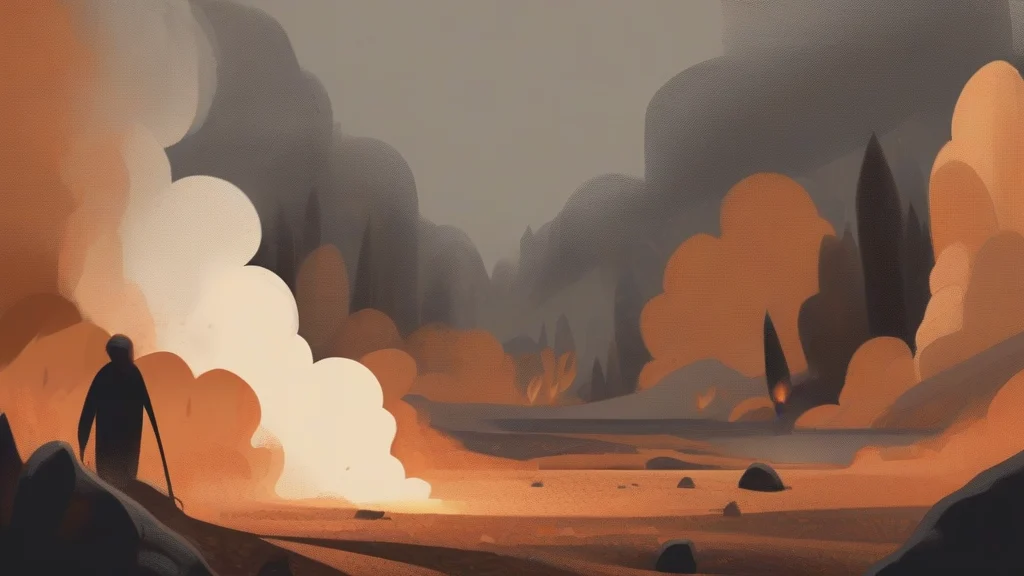
Cindery is an adjective describing something that consists of, is covered with, or resembles cinders — the grey, crumbly residue left behind when coal, wood, or other material burns. It can be applied literally, as in a path strewn with cindery clinker from an old furnace, or figuratively, to textures and surfaces that share that dry, powdery, ash-grey quality. In geology it appears in descriptions of volcanic scoria, whose rough, porous character closely mirrors that of furnace cinders. The word carries a neutral-to-bleak connotation: it suggests aftermath, ruin, or desolation more often than warmth, since cinders mark what remains once fire has passed. Though not among English's most common adjectives, it earns its place in nature writing, literary description, and technical prose, where writers want a single compact word to evoke the gritty, spent texture of burned matter without spelling out the scene in detail.
adjectiveResembling, consisting of, or covered with cinders; having the grey, powdery, or crumbly quality of burnt ash.
- Covered with, containing, or consisting of cinders or fine ash.
- Resembling cinders in appearance or texture — dull grey, dry, powdery, or crumbly.
"The old railway cutting was littered with cindery clinker that crunched underfoot."
"After the bonfire died down, a cindery residue drifted across the garden."
"Her voice had a cindery rasp, worn down by years of cigarettes."
Volcanologists use 'cindery' to describe the rough, porous rock thrown out by eruptions — so a single adjective can describe both your fireplace and an Icelandic volcano.
Reviewed by Deb Chak, Editor. AI-assisted content curated by RJS Tech Solutions LLP.
Etymology of cindery
Cindery is formed by adding the common adjective suffix -y to the noun cinder, which entered Middle English around the fourteenth century, probably via Old French (cendre, ultimately from Latin cinis, 'ash'). The derived adjective simply inherits this lineage, making it a cousin of words like incinerate and cinerary, which come from the same Latin root. Its exact date of first attestation is uncertain, but it has been in use for several centuries in English writing.
How cindery is actually used
A relatively rare descriptive adjective found mostly in written rather than spoken English, often in nature writing, geology, or literary prose. Neutral to slightly bleak in connotation, evoking aftermath, desolation, or industrial grime.
Easily confused with cindery
"Cinder" is a noun meaning a piece of burnt coal or wood, while "cindery" is an adjective describing something that resembles or is made of such material.