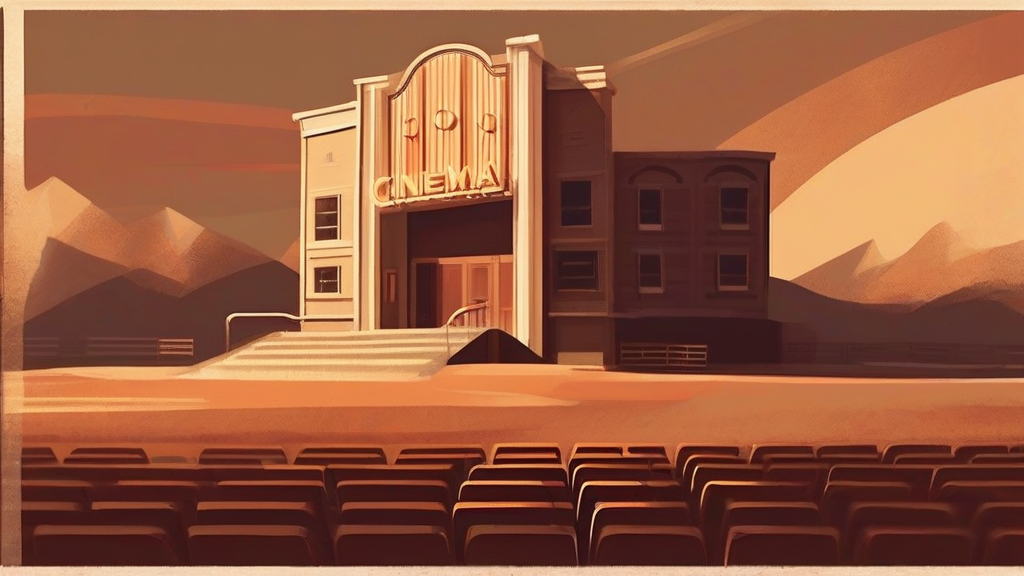
What does cinema mean?
Cinema has two closely related meanings: it is both a physical place and an art form. As a place, it refers to a theatre equipped with screens, projection equipment, and seating where audiences watch films together. As an art form, particularly in British usage, it encompasses the whole craft and business of making movies — directing, acting, editing, and production. The word derives from Greek kinema, meaning movement, via French cinématographe, the device the Lumière brothers used to project films in the 1890s. In everyday speech, Britons say they are going to the cinema, while Americans more commonly say they are going to the movies or to a movie theater. When Americans do use the word, it often carries a slightly elevated, artistic connotation, associated with serious filmmaking, festivals, and foreign or independent films rather than casual blockbuster viewing.
A theatre where films are shown to the public.
"There's a small independent cinema just around the corner that shows classic films on Sundays."
British speakers typically use the definite article: "go to the cinema."
The art or industry of making films.
"She studied cinema at film school before turning to documentary work."
This sense is standard in British English; American English usually says "film" or "movies" instead.
The plural applies mainly to the venue sense — multiple theaters. The abstract art-form sense of "cinema" is normally uncountable and takes no plural.
"Several cinemas in the city centre have closed since streaming took off."
The word "cinema" comes from a Greek word meaning movement — so every trip to the pictures is literally named after motion.
Reviewed by Deb Chak, Editor. AI-assisted content curated by RJS Tech Solutions LLP.
Etymology of cinema
Cinema comes from the Greek kinema (genitive kinematos), meaning "movement," from the verb kinein, "to move." It entered English by way of the French cinématographe, the combined camera-and-projector developed in the 1890s, most famously by Auguste and Louis Lumière. The word was shortened from cinematograph and came to mean both the apparatus and, soon after, the venue and art of moving pictures. Related English words sharing the same Greek root include kinetic and kinesiology.
How cinema is actually used
In British English "cinema" covers both the venue and the medium — people say "go to the cinema" where Americans say "go to the movies" or "go to a movie theater." In American English, using "cinema" for the medium tends to sound slightly formal or artistic, often reserved for serious or foreign film. The British informal term "the flicks" is dated but still understood.
Easily confused with cinema
"Cinematic" is an adjective describing anything that looks or feels like film, while "cinema" is the noun for the movie theater or the art of filmmaking itself.