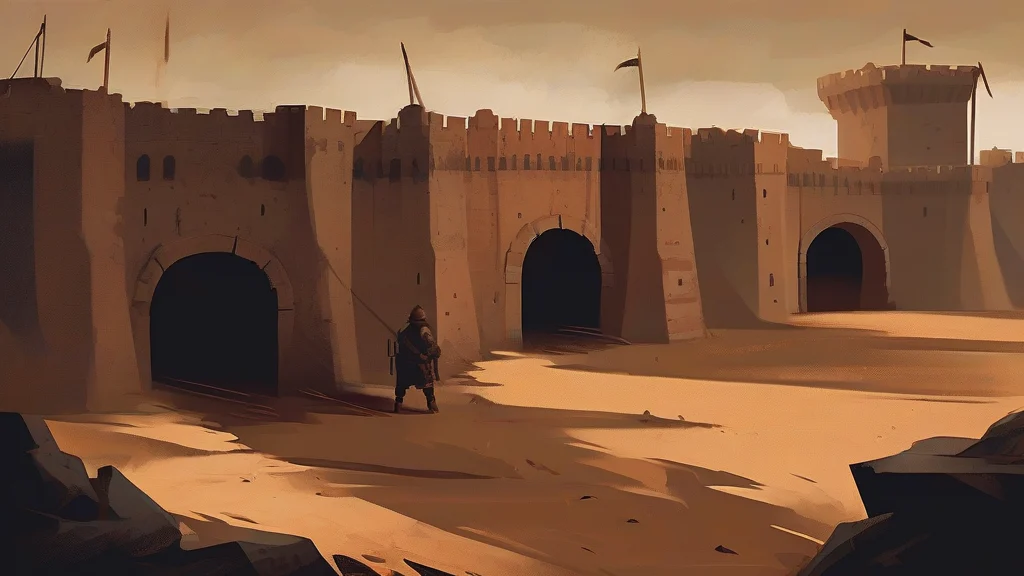
What does circumvallation mean?
Circumvallation is a term from the vocabulary of siege warfare denoting a continuous line of walls, ramparts, and trenches thrown up by an attacking army to completely encircle a fortified position. Its purpose is to cut the defenders off from reinforcement, resupply, or escape. The most famous example is Caesar's siege of Alesia in 52 BC, where Roman forces built an outward-facing circumvallation alongside an inward-facing counterpart — the contravallation — trapping the garrison while holding off a vast relief army. The word derives from Latin circumvallare, 'to surround with a rampart', combining circum ('around') with vallum ('rampart'). Today it survives mainly in military history, classical studies, and archaeology, where it is prized for its precision: it names a specific engineering achievement rather than a siege in general. Though formal and somewhat rare, it remains a vivid term for total enclosure.
nounA rampart or wall built around a besieged position, especially one constructed by an attacking army to encircle and isolate a fortified place; by extension, any enclosing ring of defensive fortifications.
- The principal sense: a continuous line of fortifications erected by a besieging army around a fortified place to seal it off from reinforcement or escape.
- By extension: any enclosing circuit of defensive works or walls surrounding a town, camp, or position.
"Caesar's circumvallation at Alesia cut the Gallic stronghold off from all outside relief."
"The Roman engineers completed their circumvallation in under a month, entrenching the entire hilltop."
"Medieval chronicles describe the double circumvallation that left the city starved between two walls."
The plural appears occasionally in archaeological or military-history contexts when referring to the siege works of several different sites or campaigns; it is uncommon in ordinary prose.
"The survey catalogued the surviving traces of Roman circumvallations across the region."
At the siege of Alesia in 52 BC, Julius Caesar built not one but two rings of walls — an outer circumvallation to keep reinforcements out, and an inner contravallation to trap Vercingetorix in.
Reviewed by Deb Chak, Editor. AI-assisted content curated by RJS Tech Solutions LLP.
Etymology of circumvallation
Circumvallation comes from Latin circumvallare, meaning 'to surround with a rampart', formed from circum ('around') and vallum ('rampart' or 'wall'). The term passed into English in the sixteenth century, when Renaissance writers on military affairs translated classical accounts of siegecraft. It shares its Latin root with cognates such as circumvent, circumscribe, and circumference, all built on the same prefix circum. Its close companion term, contravallation, describes the inward-facing wall and is frequently paired with it in historical accounts.
Related word forms
How circumvallation is actually used
Formal, technical, and largely confined to military history, archaeology, and classical scholarship. It is rarely used outside discussions of siege warfare, so in general prose it may read as obscure; 'siege lines' or 'encirclement' are more accessible alternatives.
Easily confused with circumvallation
Circumvallation is the wall built by attackers facing outward toward would-be relievers, while contravallation is the second wall facing inward to contain the defenders of the besieged place.