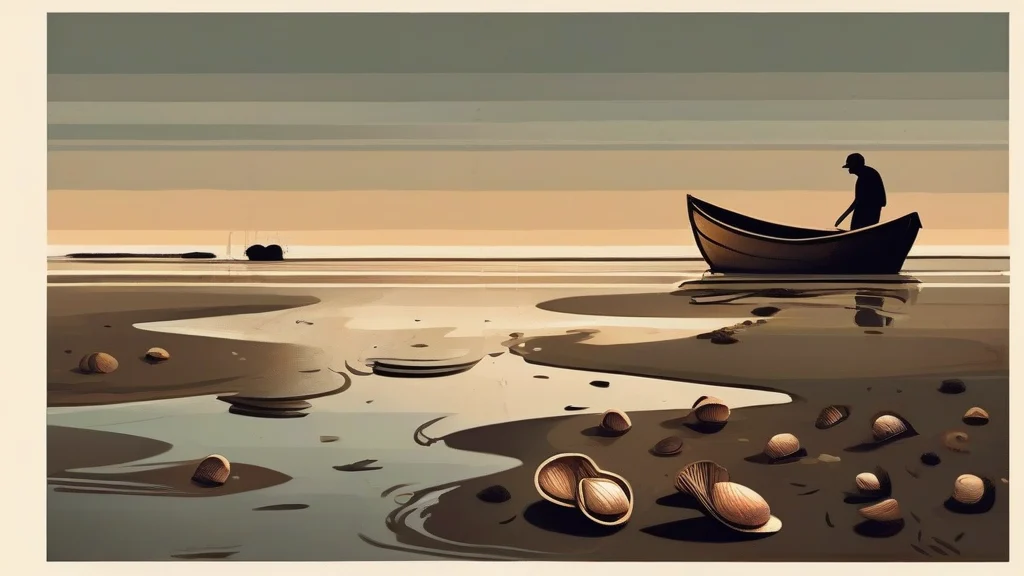
What does clamming mean?
Clamming refers to the practice of digging for clams, usually at low tide along mudflats, sandbars, and shallow coastal waters. It can be a commercial occupation, a subsistence activity, or simply a popular pastime, particularly along the Atlantic coast of the United States, where it has deep roots in local food traditions. People who go clamming typically use short-handled rakes, hoes, or even their bare feet to locate clams buried just beneath the surface, often guided by small holes or 'shows' that reveal where a clam has siphoned air or water. The activity requires a modest amount of equipment and skill, though most regions regulate it through licensing, size limits, and seasonal restrictions to protect shellfish populations. Culturally, clamming carries warm connotations of coastal life, family outings, and fresh seafood, evoking images of bucket-carrying diggers wading through tidal flats on a summer morning.
verb (gerund/present participle)The activity of digging for clams, typically at low tide on mudflats or in shallow coastal waters, either for food or for sale.
- Digging for clams in tidal flats or shallow water, as a commercial, subsistence, or recreational activity.
"We spent the whole Saturday morning clamming in the flats behind the island."
"Low tide revealed acres of mudflat perfect for clamming."
"He got his clamming permit renewed before the season opened."
For generations of New Englanders, going clamming wasn't a hobby — it was how you paid the bills and put dinner on the table, often on the same tide.
Reviewed by Deb Chak, Editor. AI-assisted content curated by RJS Tech Solutions LLP.
Etymology of clamming
Clamming derives from the verb 'to clam,' which in turn comes from the noun 'clam,' a bivalve mollusk whose name appeared in English by the early 16th century, likely as a shortened or altered form of earlier terms such as 'clamshell' or related to the older sense of 'clamp' meaning something that binds or grips tightly. The verb 'to clam' developed in American English, especially in New England, to describe the act of digging for these shellfish. Cognate forms include 'clamshell' and 'clamp,' both tracing back to Old English 'clamm,' meaning a bond or fastening.
How clamming is actually used
Informal to neutral register; strongly associated with American East Coast coastal culture, especially New England, where 'going clamming' is a common phrase. The word functions as the gerund/participle of the verb 'to clam.'
Easily confused with clamming
Claiming means asserting a right or making a demand, while clamming means digging for clams.