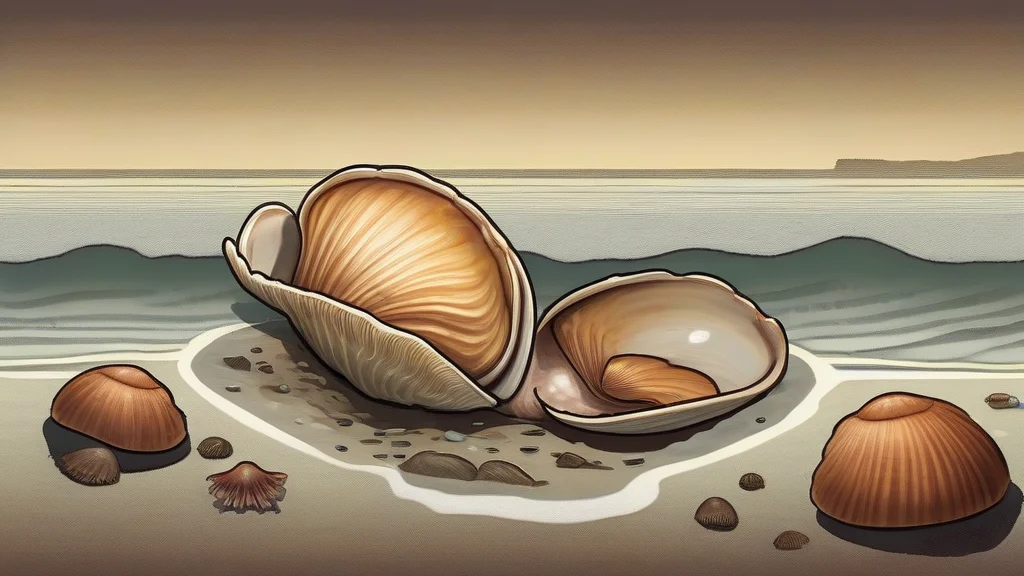
What does clam mean?
A clam is a soft-bodied aquatic mollusk protected by two hinged shells, belonging to the group known as bivalves. Clams live buried in sand or mud along coastlines and in fresh water, feeding by filtering particles from the water, and they have long been prized as food — whether steamed, fried, or simmered in the famous American dish clam chowder. The word also appears in several vivid idiomatic uses: 'clam up' means to fall suddenly silent or refuse to talk, and 'happy as a clam' describes someone perfectly content, a phrase whose logic becomes clear once you know that clams at high tide are safely beyond the reach of diggers. In older American slang, a clam could even mean a dollar. Familiar, humble, and rich in idiom, the clam is one of those everyday words that carries more cultural weight than its size suggests.
Any of various edible burrowing marine or freshwater bivalve mollusks having two shells hinged together.
"She ordered a bowl of creamy New England clam chowder."
(informal) To become silent or refuse to speak; used almost exclusively in the phrase 'clam up.'
"Under questioning, he clammed up completely."
Regular plural. The slang sense meaning dollars takes the same plural, e.g. 'fifty clams.'
"The recipe calls for a dozen fresh clams."
'Happy as a clam' sounds odd until you learn the full phrase was 'happy as a clam at high water' — high tide is when clams are safe from diggers.
Reviewed by Deb Chak, Editor. AI-assisted content curated by RJS Tech Solutions LLP.
Etymology of clam
The word clam entered English in the early modern period, appearing by the early 16th century as a term for a bivalve shellfish. Its deeper origins are uncertain; it likely derives from an Old Norse or other Germanic source, which helps explain why it has no clear Latin or Greek relatives. The verb sense in 'clam up' developed later, chiefly in American English, and the adjective 'clammy' may share a distant connection through the idea of sticking or clinging.
Related word forms
How clam is actually used
Mostly informal-to-neutral register when used literally; the slang sense meaning money ('a hundred clams') is distinctly American and casual. The verb sense occurs almost exclusively in the fixed phrase 'clam up.'
Easily confused with clam
A clamp is a device that fastens things tightly together, while a clam is an edible shellfish.