What does clast mean?
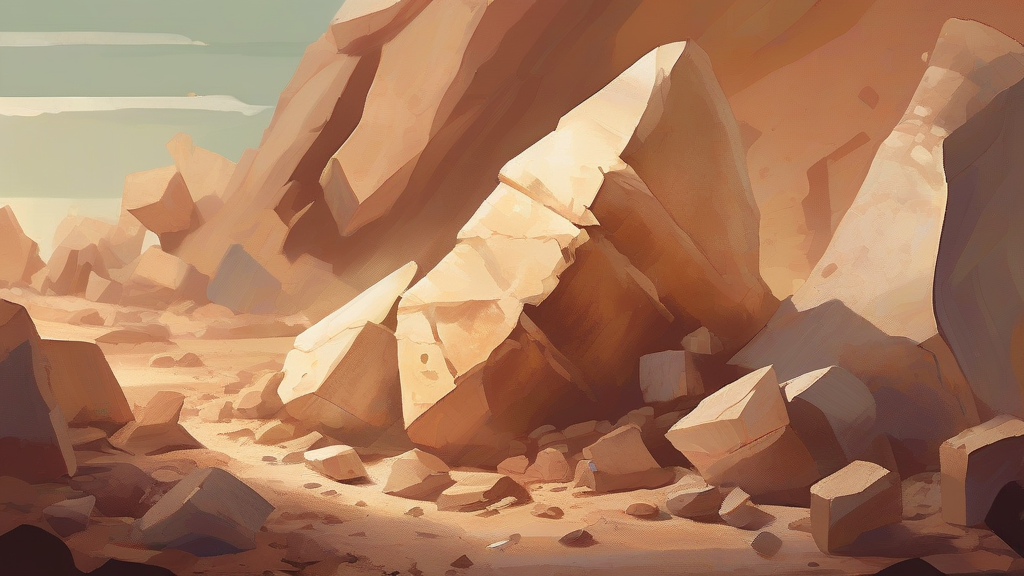
A clast is a fragment of pre-existing rock or mineral that has been broken loose by weathering, erosion, or explosive volcanic activity. Clasts are the fundamental building blocks of clastic sedimentary rocks: sand grains in sandstone, pebbles in conglomerate, and silt particles in shale are all clasts, held together by natural cements or compacted into solid rock over time. Geologists classify clasts by size — from microscopic clay particles to boulders — and by shape, since angular clasts suggest short transport from their source while well-rounded ones indicate long journeys by water or wind. The term comes from the Greek word for 'broken' and belongs to the same family as 'iconoclast'. Though strictly a technical term confined to geology and related sciences, it offers a vivid way to think about the rock cycle, in which every stone may be both the wreckage of an older rock and the raw material of a newer one.
nounA fragment of pre-existing rock or mineral produced by mechanical weathering or erosion; the constituent grain of a clastic sedimentary rock.
- A fragment of rock or mineral resulting from mechanical breakdown, forming the grains of clastic sedimentary rocks such as sandstone and conglomerate.
"The conglomerate was composed of rounded clasts of quartzite cemented together in a finer matrix."
"Thin-section analysis revealed angular clasts of volcanic glass suspended in a fine-grained matrix."
"Glacial till is poorly sorted, containing clasts ranging from clay-sized particles to house-sized boulders."
Standard pluralization; counts of individual fragments are typically reported per unit area or volume in field descriptions.
"The outcrop contained dozens of limestone clasts embedded in a reddish sandy matrix."
Every pebble in a conglomerate is a clast — a broken piece of an older rock given a second life as a building block of a new one.
Reviewed by Deb Chak, Editor. AI-assisted content curated by RJS Tech Solutions LLP.
Etymology of clast
The word 'clast' derives from the Greek 'klastos', meaning 'broken', itself formed from the verb 'klaō' ('to break'). It entered English scientific vocabulary in the late nineteenth century alongside the adjective 'clastic', as geologists formalized the study of sedimentary rocks built from fragments. It shares this root with 'iconoclast' ('breaker of images') and with terms such as 'cataclasm', all pointing to the same Greek idea of shattering.
Related word forms
How clast is actually used
A technical term used almost exclusively in geology, sedimentology, and petrology; it is rare in everyday speech and carries no emotional connotation. Clasts are often described by size (from clay to boulder) and by shape as either angular or rounded, reflecting how far they have been transported.
Easily confused with clast
An iconoclast is a person who attacks cherished beliefs or institutions, whereas a clast is a physical fragment of rock.