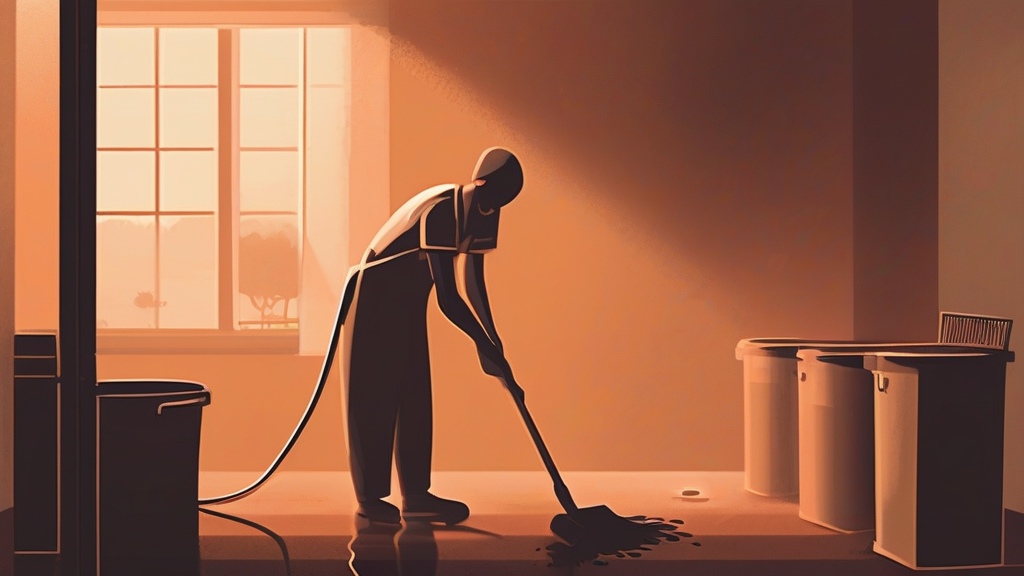
What does cleaner mean?
A cleaner is most commonly understood as a person whose occupation is cleaning buildings, offices, or homes, typically working behind the scenes to keep shared and private spaces hygienic and orderly. The word also covers machines built for cleaning — the vacuum cleaner being the classic household example — and liquid or chemical preparations sold as household cleaners. In its adjective form, cleaner is simply the comparative of 'clean', used to describe something less dirty or more tidy than another. The noun carries largely neutral connotations, though the work it names has historically been undervalued and low-paid, making it a word bound up with questions about labor and dignity. In British English, 'the cleaners' often refers to a dry-cleaning shop, giving rise to the well-known idiom 'to take someone to the cleaners', meaning to beat them decisively or relieve them of their money. Versatile, everyday, and quietly essential, the word sits at the intersection of domestic life, commerce, and language play.
A person whose job is to clean rooms, buildings, or other places; also, a device or substance used for cleaning things.
"The cleaner mopped the entire lobby before the guests arrived."
When preceded by 'dry', it refers to a dry-cleaning business rather than a cleaning person.
The comparative form of 'clean': describing something as more free from dirt, marks, or impurities than something else.
"After the renovation, the kitchen looked far cleaner than before."
Used attributively or predicatively like other comparatives; never takes '-est'; the corresponding superlative is 'cleanest'.
The plural 'cleaners' denotes multiple cleaning people, devices, or products; in British English it also idiomatically means a dry-cleaning establishment.
"Both cleaners were given new uniforms at the hotel."
The modern dry cleaner traces back to 1821, when Thomas Jennings became the first Black American to receive a U.S. patent — for his 'dry scouring' method of cleaning clothes.
Reviewed by Deb Chak, Editor. AI-assisted content curated by RJS Tech Solutions LLP.
Etymology of cleaner
The word cleaner derives from the Old English adjective 'clǣne', meaning free from dirt or impurity, which descends from a Proto-Germanic root (*klainiz) shared with related Germanic languages. The agent suffix '-er' was attached in Middle English to form a noun denoting someone who cleans. Its closest relatives within English are the sibling forms of the same root: 'clean', 'cleanse', 'cleanly', and 'cleanliness'. The specialized sense referring to dry-cleaning establishments emerged in the nineteenth century alongside commercial garment-cleaning technology.
How cleaner is actually used
As a noun referring to a person, 'cleaner' is standard in both British and American English, though American usage often favors job titles like 'janitor' or 'custodian' for institutional settings. The plural 'cleaners' commonly refers collectively to a dry-cleaning establishment, especially in British English ('take it to the cleaners'), which has also produced the figurative phrase 'to take someone to the cleaners', meaning to defeat them thoroughly or drain their money.
Easily confused with cleaner
A cleanser is specifically a cleansing product or agent (such as a facial or surface wash), while a cleaner can be a person, a machine, or any cleaning substance.
'Clearer' is the comparative of 'clear' (more transparent or easier to see/hear) and has nothing to do with cleanliness, despite the similar spelling.