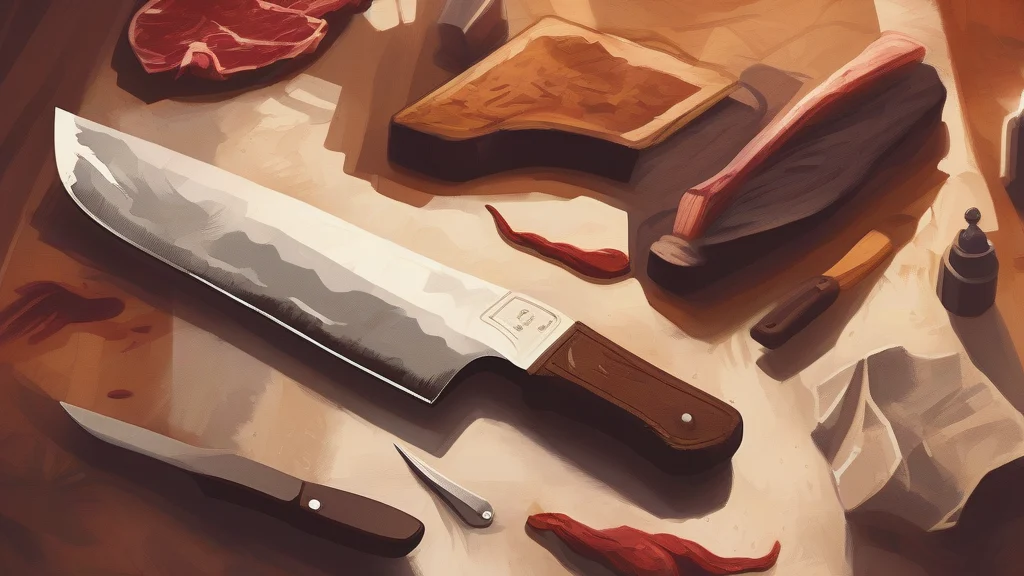
What does cleaver mean?
A cleaver is a large, heavy knife distinguished by its broad rectangular blade, designed for chopping through meat and bone rather than slicing with precision. The weight of the blade does much of the work: the cook or butcher raises it and lets momentum drive it through joints and cartilage. Beyond Western butcher shops, the cleaver holds a central place in Chinese and Southeast Asian kitchens, where lighter versions handle everything from mincing garlic to crushing ginger. The word derives from the verb 'cleave,' from Old English clēofan, meaning to split — though that same ancient verb curiously came to carry the opposite sense of adhering firmly. Because of its association with butchery, the cleaver sometimes appears as a menacing prop in fiction, lending the word a faintly dramatic connotation despite its everyday culinary role. It remains one of the few knives whose design has changed little over centuries.
nounA heavy, broad-bladed knife used by butchers for chopping meat and cutting through bone. In computing slang, it can also refer to a program that splits files into parts, but the primary meaning is the kitchen or butcher's tool.
- A heavy broad-bladed knife used for chopping meat and cutting through bone.
- A person who or thing that cleaves or splits something.
"The butcher swung the cleaver down through the joint with a single decisive blow."
"She raised the cleaver and brought it down cleanly through the bone."
"In Chinese kitchens, the versatile cleaver serves as knife, scraper, and scoop all at once."
Standard plural; note that 'cleavers' is also the established common name of a weedy plant (Galium aparine), so the plural form is ambiguous out of context.
"The shop displayed several cleavers on the wall, each sized for a different task."
The same Old English root that gives us 'cleaver' also gives us the verb 'to cleave' — which famously means both to split apart AND to cling together.
Reviewed by Deb Chak, Editor. AI-assisted content curated by RJS Tech Solutions LLP.
Etymology of cleaver
'Cleaver' is an agent noun formed from the Middle English verb 'cleven,' from Old English clēofan, meaning to split or cut apart, which traces back to Proto-Germanic *kleubaną. Cognates include German 'Kloben' and related forms in Dutch and the Scandinavian languages. The tool itself dates to medieval Europe, where heavy blades for breaking down carcasses were standard equipment in butcher trades.
How cleaver is actually used
Mostly neutral register; strongly associated with butchery and East Asian cooking. Figurative use ('a political cleaver') is rare. The agent noun sense ('one who cleaves') is chiefly historical or technical.
Easily confused with cleaver
The word 'cleaver' can also name a sticky annual plant of the bedstraw family; context distinguishes the tool from the weed.
'Clover' is a three-leaved plant, unrelated to the knife; the words differ in vowel sound and spelling.