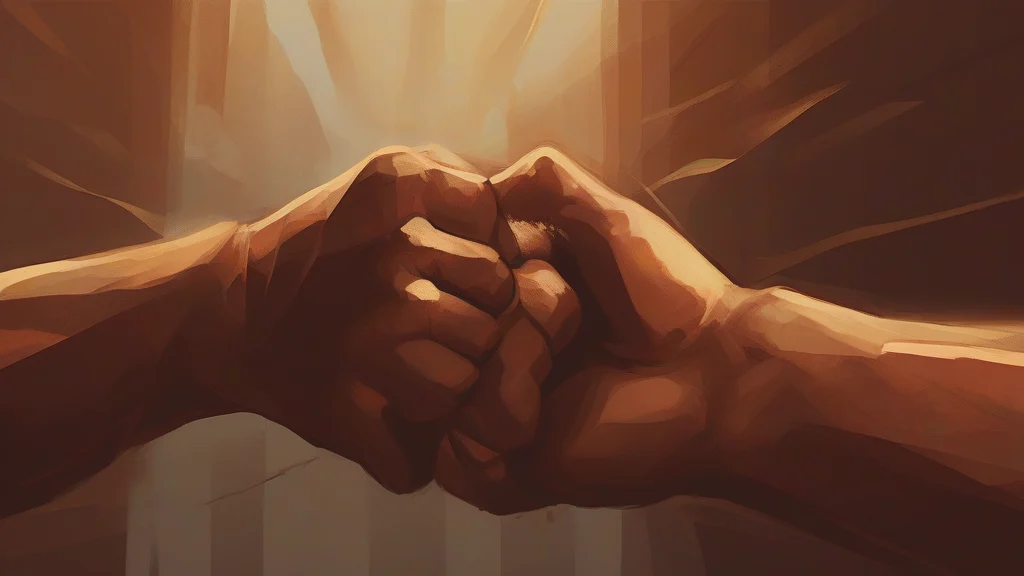
What does clenched mean?
Clenched is the past tense and past participle of the verb clench, meaning to press or squeeze tightly together. It is used most commonly of the body: fists are clenched in anger, jaws are clenched under stress, and teeth are clenched in pain or determination. Beyond anatomy, it can describe gripping an object so firmly that it cannot be pulled away. The word carries strong emotional connotation — a clenched fist or jaw almost always signals tension, defiance, or suppressed feeling, which makes it a favourite of novelists and journalists describing character under pressure. Historically, clench was a variant of clinch, both descending from Old English forms meaning to hold fast or make secure; over time the two diverged, with clinch coming to signify settling a matter decisively or holding an opponent in wrestling. Knowing clenched gives writers and readers a precise shorthand for physical manifestations of emotion.
verb (past tense and past participle of clench)Past tense and past participle of clench: to press or squeeze something tightly together, especially to close (the teeth or fist) firmly, or to grip something with such force that it cannot be released easily.
- To have pressed or squeezed tightly shut, as teeth or a fist, typically expressing anger, tension, or determination.
- To have gripped or held something so firmly that it cannot easily be taken away.
"She clenched her fists so tightly that her knuckles turned white."
"He clenched his jaw and said nothing."
"The climber kept the rope clenched in one hand."
Clench and clinch were once interchangeable variants of the same Old English word — one came to mean gripping tight, the other sealing the deal.
Reviewed by Deb Chak, Editor. AI-assisted content curated by RJS Tech Solutions LLP.
Etymology of clenched
Clenched derives from the verb clench, which emerged in Middle English as a variant of clinch; both trace back to Old English verbs meaning to hold fast, make firm, or cling. The underlying root is shared with the verb cling, reflecting an ancient Germanic idea of gripping or adhering tightly. Over the centuries clench and clinch drifted apart in usage, with clench settling into its modern sense of pressing or squeezing shut and clinch developing senses around securing or settling conclusively.
Related word forms
How clenched is actually used
"Clenched" is most often used of body parts — fists, jaws, teeth — where it signals suppressed emotion such as anger, anxiety, or resolve. It appears mainly in figurative or descriptive prose rather than everyday speech about objects, where "gripped" or "held" would be more natural.
Easily confused with clenched
Clinch means to settle conclusively or to hold someone closely (as in boxing), while clench refers to tightening or gripping — though the two words share the same Old English root and are historical variants.