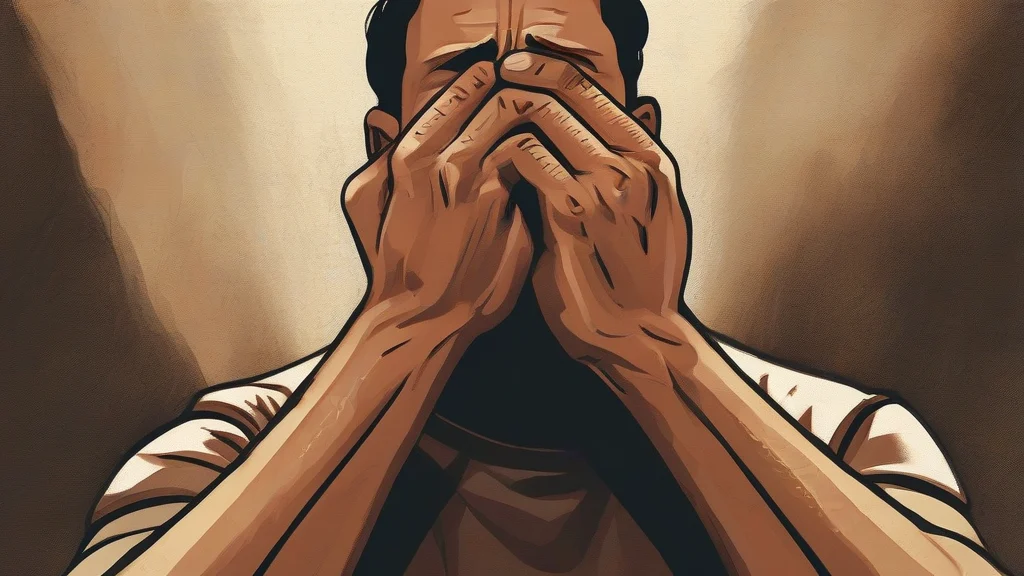
What does clenching mean?
"Clenching" refers to the act of closing or gripping something tightly, whether with the hand, the jaw, or another part of the body. As the present participle of the verb "clench," it most often describes a sustained physical response to strong emotion: a person might be seen clenching their fists in frustration, clenching their teeth through pain, or clenching their jaw to hold back words. Because the gesture is so closely tied to suppressed anger, anxiety, and determination, the word carries a distinctly tense connotation and appears frequently in both everyday description and literary writing as a signal of feeling left unspoken. It can also describe more literal fastening, such as clenching a nail so its point bends flat against a surface. A related noun form names the act itself — a single clench of the fist. Distinct from "clinch," which means to settle or secure conclusively (a deal, an argument), clenching remains firmly about physical pressure and grip, making it one of the most vivid small words for the body's involuntary honesty.
To close or squeeze tightly, especially the fists, jaw, or teeth; to grip firmly; to fasten by bending back a protruding end, as with a nail.
"She walked out of the room, clenching her fists so hard her knuckles turned white."
Almost always transitive in modern use (clenching something); used continuously to suggest sustained tension.
An act of clenching; a tight grip or contraction of a muscle or the hand.
"A brief clenching of his jaw was the only sign of his irritation."
Your body clenches before your brain even registers fear — dentists can spot a stressed patient just by looking at their worn-down molars.
Reviewed by Deb Chak, Editor. AI-assisted content curated by RJS Tech Solutions LLP.
Etymology of clenching
The verb "clench" descends from Old English "beclencan" and related Germanic forms meaning to hold fast or grip, sharing deep roots with words like "cling." Its close relative and historical variant "clinch" — still common in boxing and in idioms about settling matters — developed from the same stock, and the two spellings circulated interchangeably for centuries before settling into their modern, distinct senses. The form "clenching" simply follows the standard English pattern for present participles and verbal nouns.
Related word forms
How clenching is actually used
Most commonly used in the continuous sense ('was clenching', 'kept clenching') to convey ongoing tension. Strongly associated with suppressed emotion — anger, anxiety, resolve — so writers use it as shorthand for what a character refuses to say aloud. In informal speech, 'clench' occasionally carries scatological humor when referring to other muscles, but this is colloquial rather than standard usage.
Easily confused with clenching
'Clinch' means to settle decisively or secure something (as in 'clinch a deal'), while 'clench' means to grip or tighten physically.