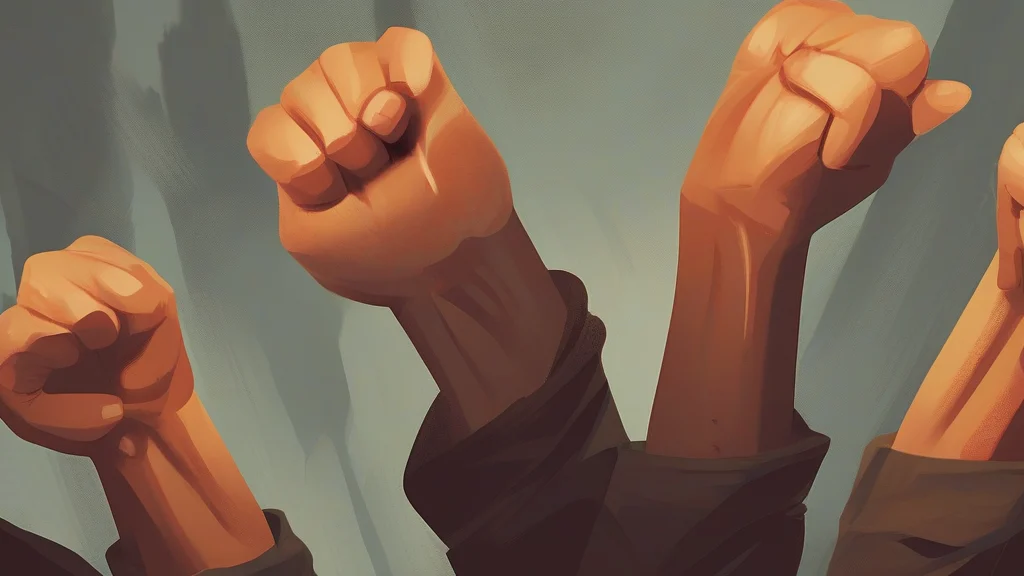
What does clench mean?
Clench is a verb meaning to close, grip, or press something tightly, most commonly applied to parts of the body: clenching one's fists in anger, clenching one's teeth against pain, or clenching one's jaw in frustration or determination. It can also describe gripping an object firmly, such as clenching a rope or a tool. The word carries strong connotations of tension, effort, and suppressed emotion, which makes it a favourite of novelists describing characters under stress. It also exists as a noun denoting a tight grip or clamp. Closely related in form and history is "clinch," which today generally means to secure conclusively or to embrace tightly; the two words share a common origin but have diverged in meaning. Clench is standard throughout the English-speaking world and suits both literal description and figurative, emotionally charged writing.
To close or grip tightly, especially to press the teeth together or squeeze the hand into a fist; also, to hold or fasten something firmly.
"She clenched her teeth against the cold."
Most frequently used of fists, teeth, and jaw.
A tight grip or clamping action.
"The blacksmith gave the nail a firm clench."
Less common than the verb; in metalwork, a clench can refer to a fastening made by bending back a projecting end.
"Clench" and "clinch" were once the same word — they split apart over centuries into a word for gripping tight and a word for settling a deal.
Reviewed by Deb Chak, Editor. AI-assisted content curated by RJS Tech Solutions LLP.
Etymology of clench
Clench derives from Old English "clencan," meaning to cling or hold fast, and is related to Old English "clincan." It shares an ancient Germanic root with "clinch" and "cling," all pointing to notions of sticking fast or holding tight. The words clench and clinch were long used interchangeably before differentiating in modern usage.
Related word forms
How clench is actually used
Most often used of body parts under stress — fists, teeth, jaw — where it conveys tension, anger, determination, or suppressed emotion. Also used literally for gripping tools or objects. Register is neutral; common in both narrative prose and everyday speech.
Easily confused with clench
Clinch means to settle conclusively or to embrace/grapple closely, whereas clench means to grip or tighten physically.