
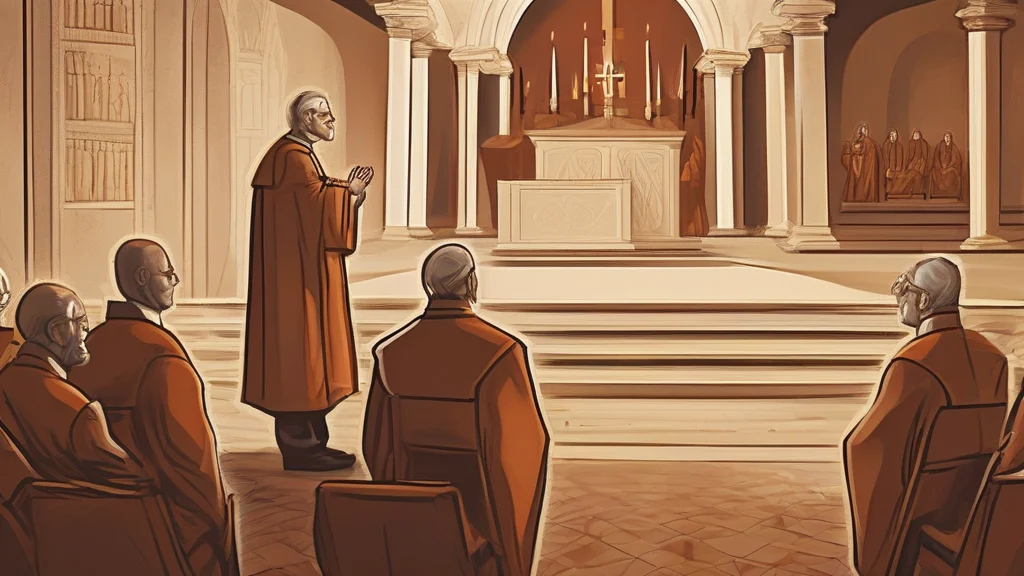
What does clericalism mean?
Clericalism is the doctrine or practice of extending the power and influence of the clergy — or of a church as an institution — into political and public life. The word is nearly always pejorative: to accuse a government, school system, or political movement of clericalism is to suggest that religious officials are wielding undue authority over secular affairs. The term rose to prominence in nineteenth-century Europe, where struggles between church and state were central to politics; in France, Italy, Spain, and much of Latin America, movements dedicated to reducing church power defined themselves explicitly in opposition to clericalism. Its natural opposite is anticlericalism, the active resistance to such influence. Today the word appears mainly in historical writing and in contemporary debates about religion's role in government, making it a precise and useful term for anyone discussing the boundary between sacred and secular authority.
nounThe policy or principle of extending the influence and power of the clergy, or of a church hierarchy, into political and public life. It is typically used critically to describe excessive or undue involvement of religious officials in secular affairs.
- The policy or practice of extending the power and influence of the clergy or church into political and public life, usually used pejoratively.
"The new constitution was praised for its firm rejection of clericalism."
"The party's platform called for a strict separation of church and state, condemning what it saw as creeping clericalism in public education."
"Historians of the Third Republic often describe anticlerical legislation as a direct response to decades of entrenched clericalism."
Rarely pluralized; the uncountable singular form is standard, though the plural may appear when referring to distinct historical manifestations of the phenomenon.
"Different national traditions produced very different clericalisms across nineteenth-century Europe."
In 19th-century Europe, "clericalism" was such a charged word that shouting "Death to clericalism!" could start a riot — it became the battle cry of secularists fighting church power over the state.
Reviewed by Deb Chak, Editor. AI-assisted content curated by RJS Tech Solutions LLP.
Etymology of clericalism
Clericalism derives from "clerical," the adjective relating to clergy, combined with the suffix "-ism" denoting a doctrine or practice. The root traces back through Late Latin "clericus" (a member of the clergy), from Greek "klērikos" (of the clergy), which itself comes from "klēros," meaning "lot" or "inheritance" — a reference to the clergy as those chosen by lot or set apart. Cognates include "clergy," "cleric," and, more distantly, "clerk." The term entered English in the mid-nineteenth century amid European church–state conflicts.
Related word forms
How clericalism is actually used
Clericalism is almost always used with a negative connotation, carrying an implication that clergy influence has become excessive or improper. It is a formal, largely political and historical term, most common in discussions of European history (especially France, Italy, Spain, and Latin America) and in debates over church–state relations. The opposing stance is known as anticlericalism.
Easily confused with clericalism
"Clerical" is an adjective meaning relating to the clergy or to office work, while "clericalism" is the noun denoting the doctrine or practice of clergy influence in public affairs.
"Clericism" is a rare variant term for the same idea, but "clericalism" is the standard, widely used form.