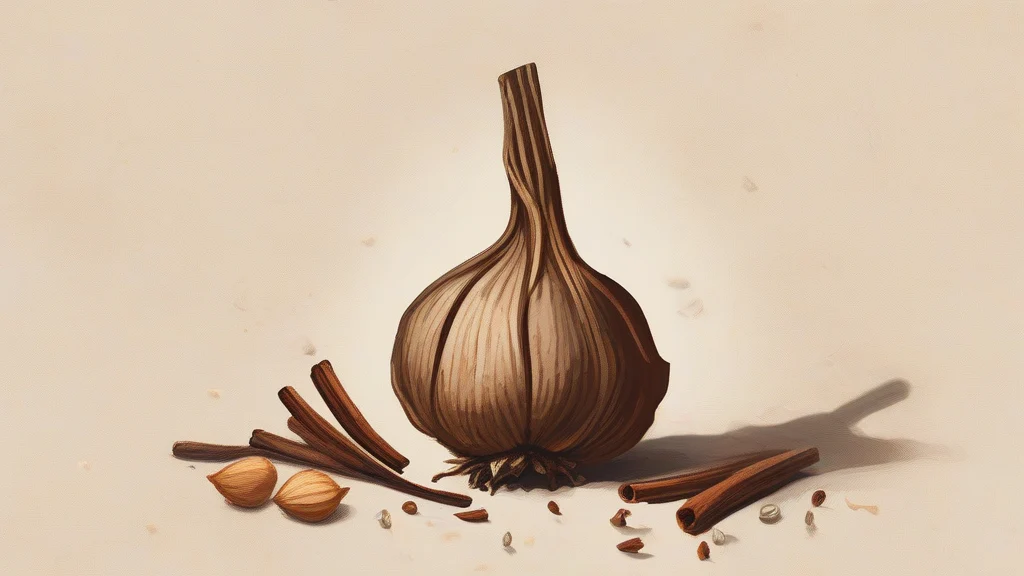
What does clove mean?
A clove is, in its primary modern sense, the small, dried, unopened flower bud of an evergreen tree native to the Moluccas, or Spice Islands, of Indonesia. Intensely aromatic and warming, cloves have flavored food, drink, and medicine for more than two thousand years, appearing in mulled wines, curries, baked hams, and festive desserts across many cuisines. The word also names one of the individual wedges that make up a bulb of garlic, as in 'a clove of garlic.' Both senses share an etymological root in the Latin clavus, meaning nail, since each bud was thought to resemble a small nail in shape. Cloves carry rich connotations of warmth, comfort, and seasonal celebration, particularly around winter holidays. Their historical value is hard to overstate: they once rivaled gold in price and drew European powers into voyages of exploration and colonial competition. In everyday English the word is common, informal to neutral in register, and almost always encountered in culinary contexts.
The dried aromatic flower bud of a tropical evergreen tree (Syzygium aromaticum), used whole or ground as a spice.
"Add two cloves to the spiced cider and let it steep."
Usually used in the plural when referring to the spice.
One of the separate segments forming a bulb of garlic.
"Finely mince a clove of garlic and fry it briefly in oil."
Typically counted individually, as in 'two cloves of garlic.'
Regular plural; used both for multiple spice buds and, with 'of garlic,' for multiple garlic segments.
"The recipe calls for three cloves of garlic and a pinch of ground cloves."
A 'clove' is literally a nail: the word comes from Latin clavus, because the dried flower buds were thought to resemble little iron nails.
Reviewed by Deb Chak, Editor. AI-assisted content curated by RJS Tech Solutions LLP.
Etymology of clove
The word clove entered Middle English from Old French clou, in the full phrase clou de girofle, meaning 'nail of the clove tree,' a reference to the dried bud's resemblance to a small nail. The Old French clou derives from Latin clavus, 'nail,' the same root that gives us clavicle, enclave, and clavichord. The garlic sense developed by analogy, since a segment of a garlic bulb likewise suggested a nail or wedge in shape.
How clove is actually used
In cookery contexts 'cloves' nearly always refers to the spice, while 'a clove of garlic' is the standard way to refer to a single garlic segment; the plural 'cloves' covers both senses, so context determines which is meant.
Easily confused with clove
Cleave is a verb meaning to split or adhere firmly, while clove is historically its past tense but in modern use is almost always the noun for the spice or a garlic segment.