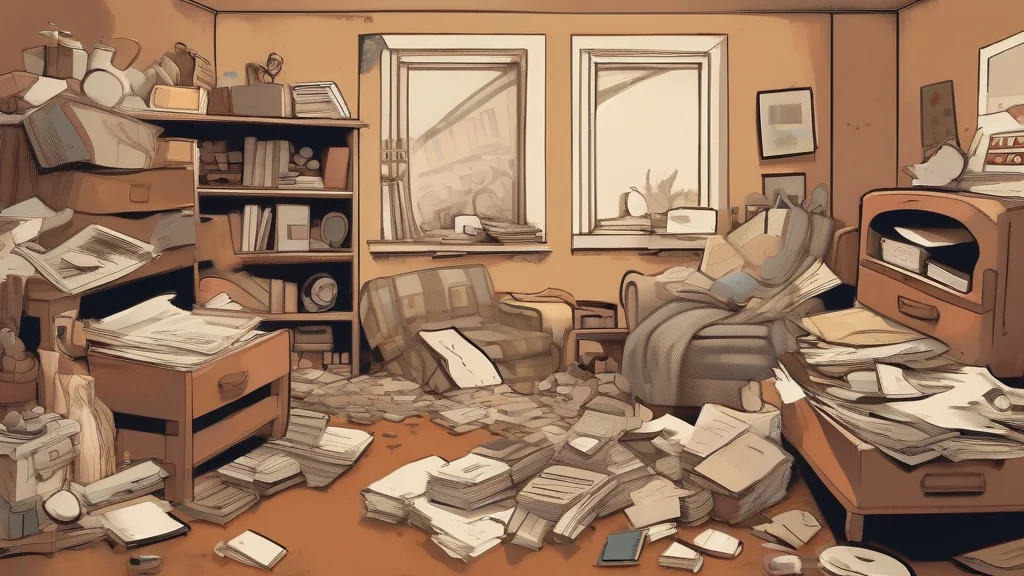
What does cluttered mean?
"Cluttered" describes a space filled with things scattered about in a disorderly way, so that the sheer quantity and arrangement of objects gets in the way of using the space. A cluttered desk, a cluttered kitchen counter, or a cluttered garage all share this quality: the items present are not inherently useless, but their haphazard arrangement creates mess and confusion. The word also extends figuratively to non-physical domains — a cluttered mind full of worries, a cluttered schedule packed with commitments, or a cluttered web page overloaded with elements. Derived from the verb "to clutter," it functions primarily as an adjective and carries mildly negative connotations, suggesting disorder, distraction, and inefficiency. Its antonyms include "tidy," "orderly," and the useful coinage "uncluttered." In everyday speech the word is common and informal-neutral, appearing frequently in discussions of home organization, productivity, and minimalist design, where decluttering one's environment is often framed as a path to mental clarity.
Filled or covered with scattered, disorderly objects; figuratively, overcrowded or confused.
"The cluttered workbench made it impossible to finish the repair quickly."
Most frequent in descriptions of rooms, desks, and surfaces; increasingly applied figuratively to minds, interfaces, and prose.
Past tense and past participle of "clutter": to fill a place with disorderly objects.
"Years of impulse buys had cluttered every shelf in the apartment."
A 'cluttered' desk may look chaotic, but researchers have found that messy environments can actually boost creative thinking.
Reviewed by Deb Chak, Editor. AI-assisted content curated by RJS Tech Solutions LLP.
Etymology of cluttered
"Cluttered" comes from the verb "clutter," which appeared in English by the late sixteenth century meaning to crowd or fill in a disorderly way. The ultimate origin of "clutter" is uncertain; lexicographers have suggested it may be related to dialect words such as "clot" and "clotter" (to congeal), which would connect it to other Germanic words for lumps or masses. Whatever its precise root, "clutter" settled into its modern senses of disorderly crowding, and its participle form became the standard adjective we use today.
Related word forms
How cluttered is actually used
"Cluttered" is the past tense and past participle of the verb "clutter," but it is most commonly used as an adjective describing spaces or, figuratively, minds and designs. It carries mildly negative connotations of disorder and inefficiency, though in design contexts it is often used neutrally as a technical criticism. The word is standard in both British and American English.
Easily confused with cluttered
"Clustered" means gathered closely together in groups, while "cluttered" means spread about messily and without order.